Investing / Stock Market
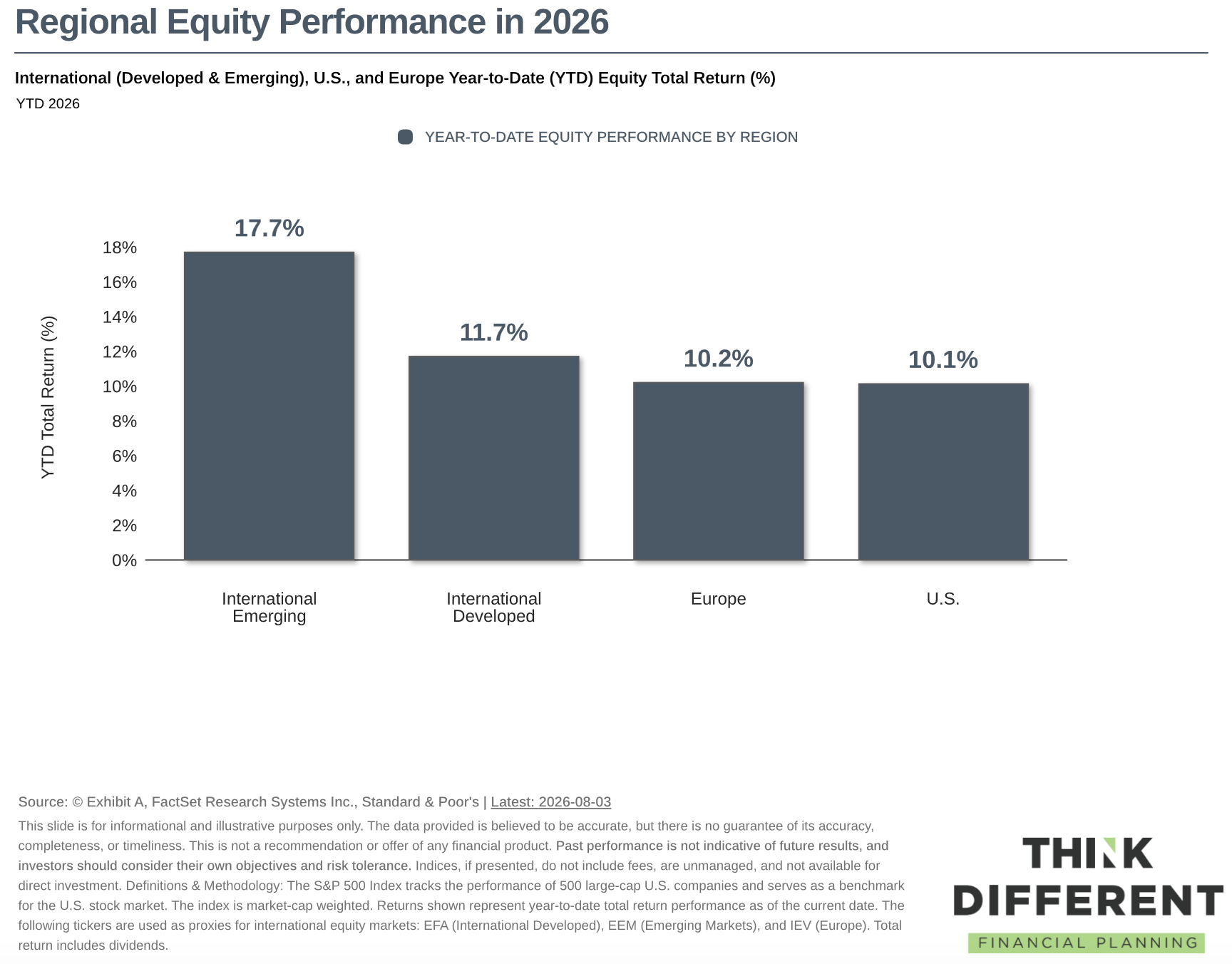
- 🌎 Stock Performance in 2026 – International stocks have done well, with emerging markets (like Taiwan and South Korea) leading the pack.
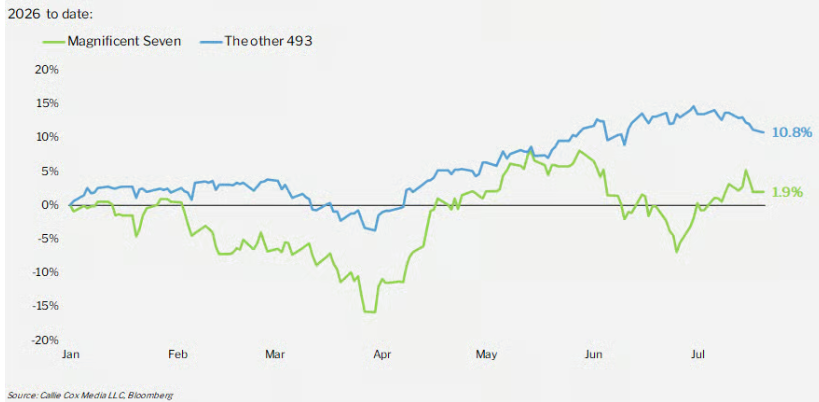
- 💪 Strong Fundamentals – For most of this bull market, a small group of mega-cap stocks has accounted for a huge share of the S&P 500’s advance. In 2026, however, that market leadership has broadened significantly, with the other 493 companies outperforming both the S&P 500 and the Magnificent Seven (Apple, Microsoft, Alphabet, Amazon, Meta, Nvidia, and Tesla).
- “Investors have long worried that heavy concentration at the top of the market would leave stocks vulnerable if the largest technology companies stumbled. So far, the opposite has occurred: strength elsewhere in the market has more than compensated, providing encouraging evidence that the bull market rests on a broader and potentially more durable foundation.Let me break down what’s actually happened in the markets. Year to date, the biggest winners [by sector] were industrials, materials, and energy. That made sense — war in the Middle East, oil prices surge, and energy stocks move higher.
- Tech is still doing well, but different tech:
- “There’s an AI-related switcheroo underway, too. The Magnificent Seven may be having an awful year, but semiconductors and hardware stocks have risen to the top. Tech, but a different flavor of tech. — Callie Cox
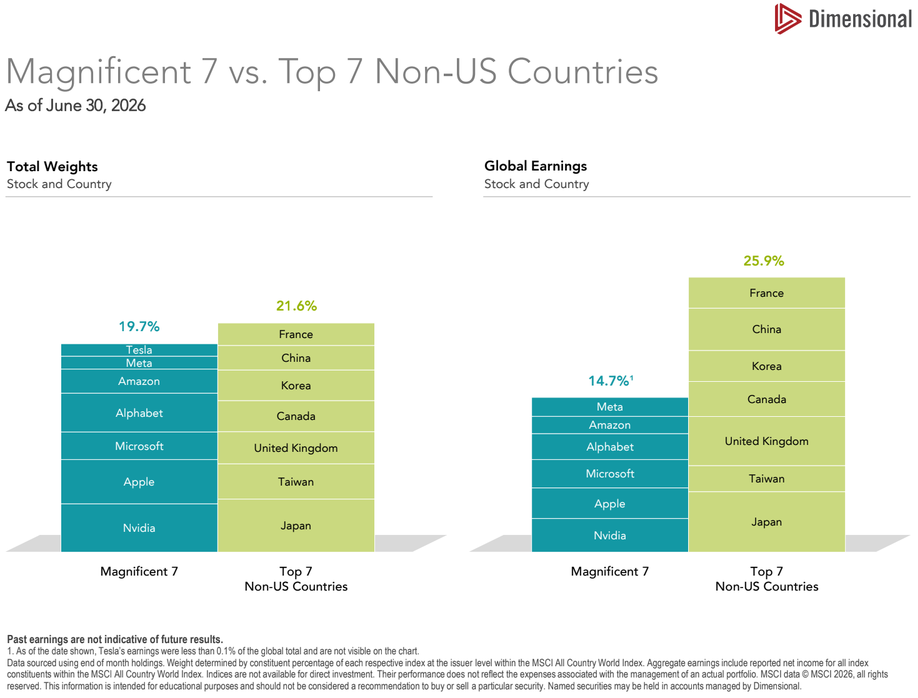
- ⚖️ 7 Stock vs. 7 Countries – Despite their underperformance this year, the Magnificent 7 stocks are still massive companies. They’re worth almost as much as the seven largest non-U.S. stock markets combined!
- However, their economic footprint is much smaller: As a group they generate 14.7% of global earnings, versus 25.9% for those seven countries.
- In other words, their market valuations far outpace their share of worldwide revenue. It’s a bet that their future growth and profitability will continue to outpace the rest of the global market.
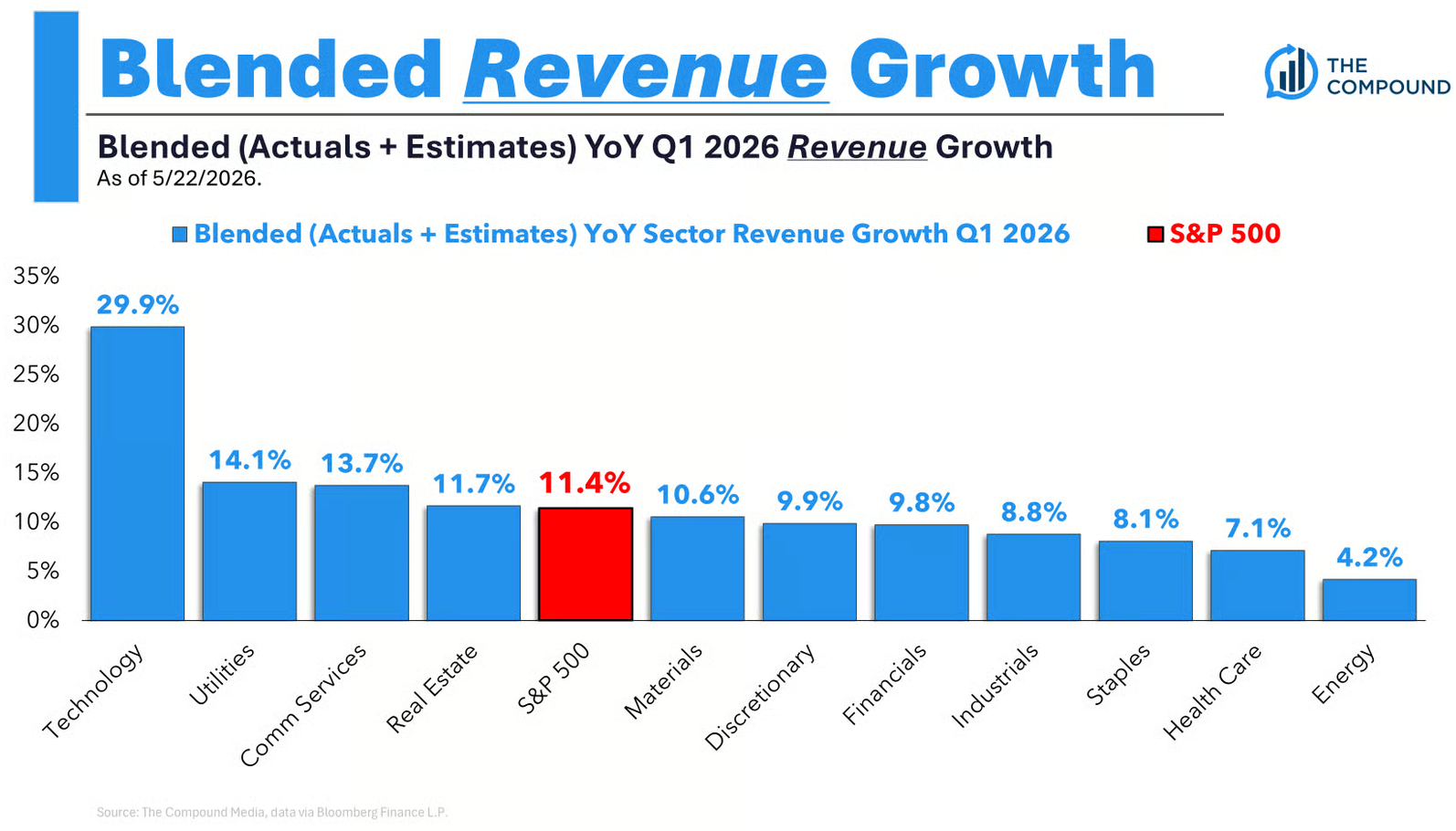
- 📈 Encouraging News – “Every single sector is expected to report a year-over-year increase in revenue.
- The S&P 500 (overall) is expected to increase revenue by 11.4% from a year ago. ” — Matt Cerminaro
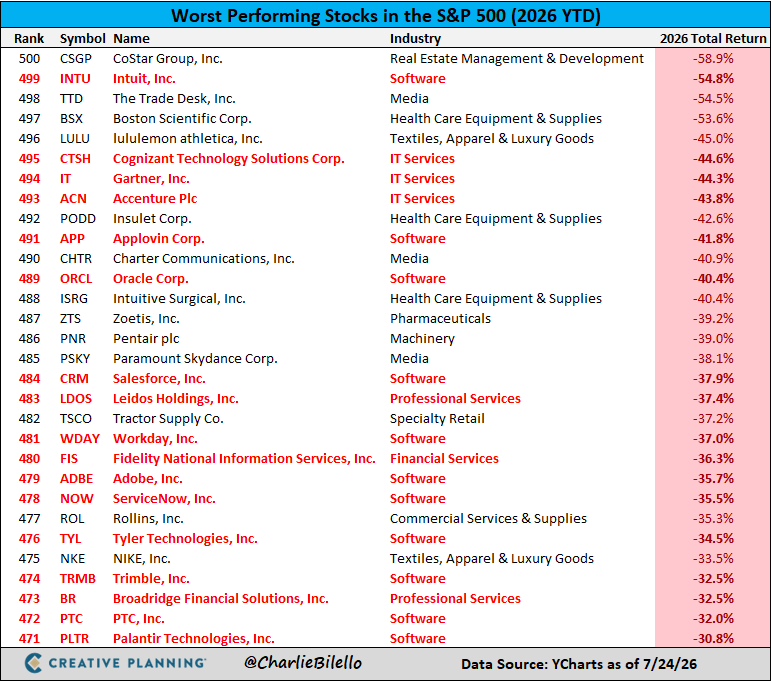
- 🤖 Worst-Performing Stocks of 2026 – Despite revenue growth across every sector, not every company is up for the year. In fact, about 1 out of 3 stocks is down in 2026. Yet another reason to diversify.
- “17 of the 30 worst-performing stocks in the S&P 500 this year are software and related services companies. Investors are betting that AI will be an existential threat to this industry.” — Charlie Bilello
- This is interesting when viewed in the context of the stats above. Basically IT services and software are down, the Mag 7 are underperforming, but semiconductors and hardware stocks are doing very well.
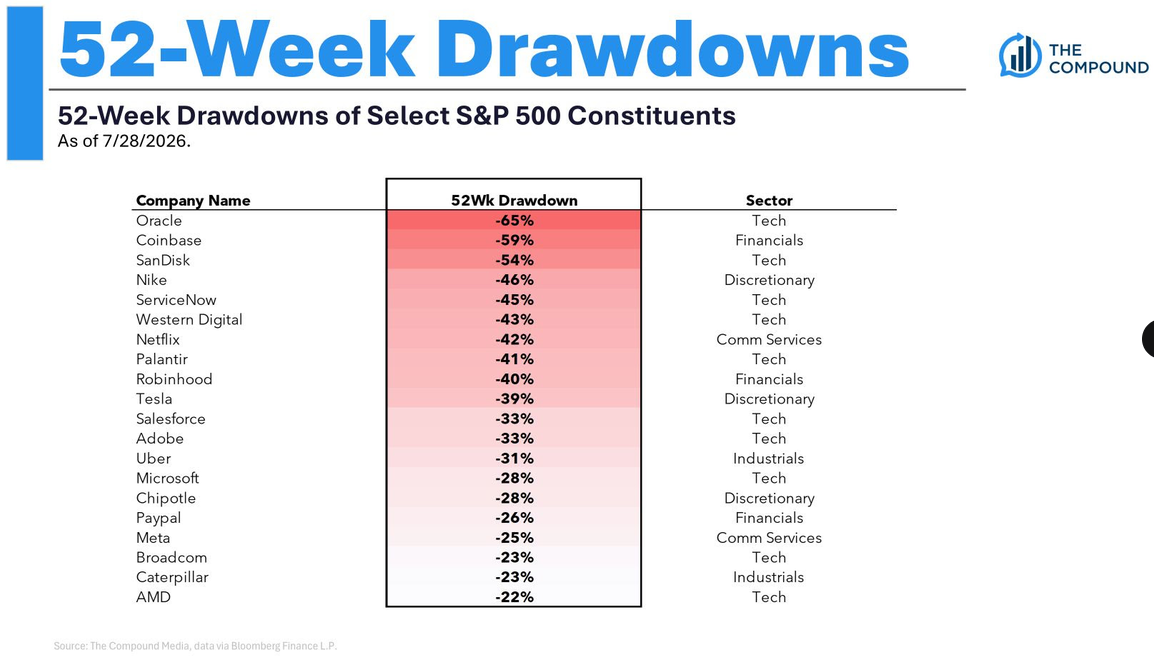
- 5️⃣2️⃣ Drawdowns – The table below looks at the data a bit differently.
- It shows how far each stock is trading below its 52-week high. Some well-known names are down a lot. And again, lots of tech:
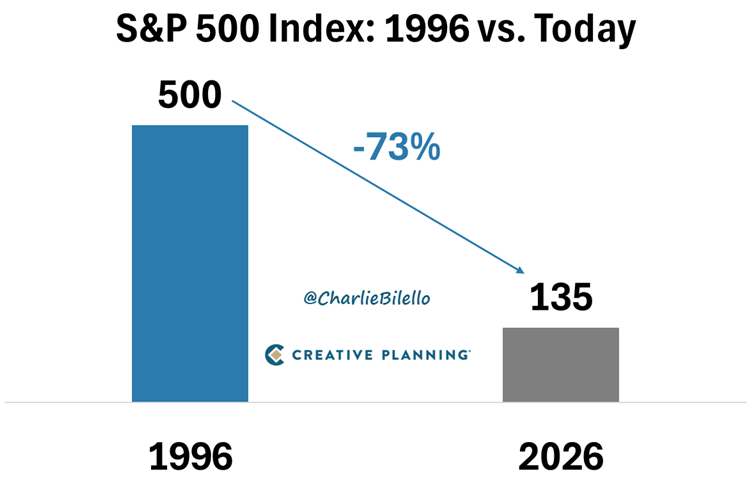
- ⏳ A Surprising Stat – Stocks that perform poorly, like those above, can be removed from the S&P 500 index (which essentially represents the largest 500 companies in the US).
- The statistic below summarized the turnover within that index over the past 30 years:
- “Only 135 of the S&P 500 constituents in 1996 are still in the index today.
- The lesson: companies change, leaders fade, and innovation never stops.” — Charlie Bilello
- 📉 Past Stock Market Declines – The U.S. stock market is at, or very close to, an all-time high.
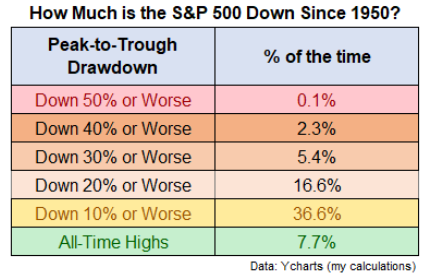
- The table below shows how often the S&P 500 has traded been below its previous peak since 1950.
- As Ben Carlson notes, “Roughly one-third of the time since 1950, the S&P 500 has been in a drawdown of 10% or worse.”
- This is a reminder that all-time highs are relatively uncommon. The market has spent only ~8% of the time there. The majority of the time, you have to live with some degree of decline, which is perfectly. normal.
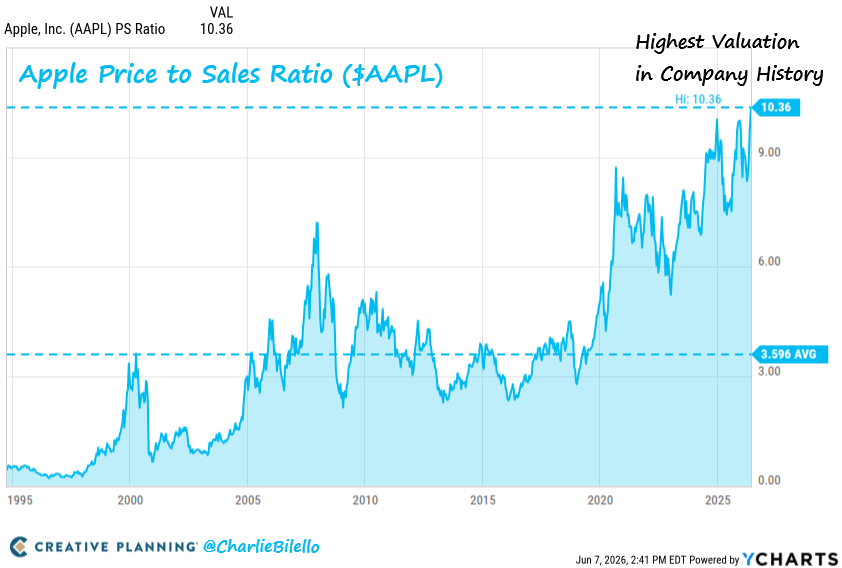
- 🖥️ Apple’s Valuation – Apple is trading at over 10x sales, the highest valuation in company history.
- Said another way, this means investors value the company at ~$10 for every $1 of annual revenue.
- Lately the company has been rewarded for not splurging on the AI/data center boom, conserving cash and maintaining their high margins instead.
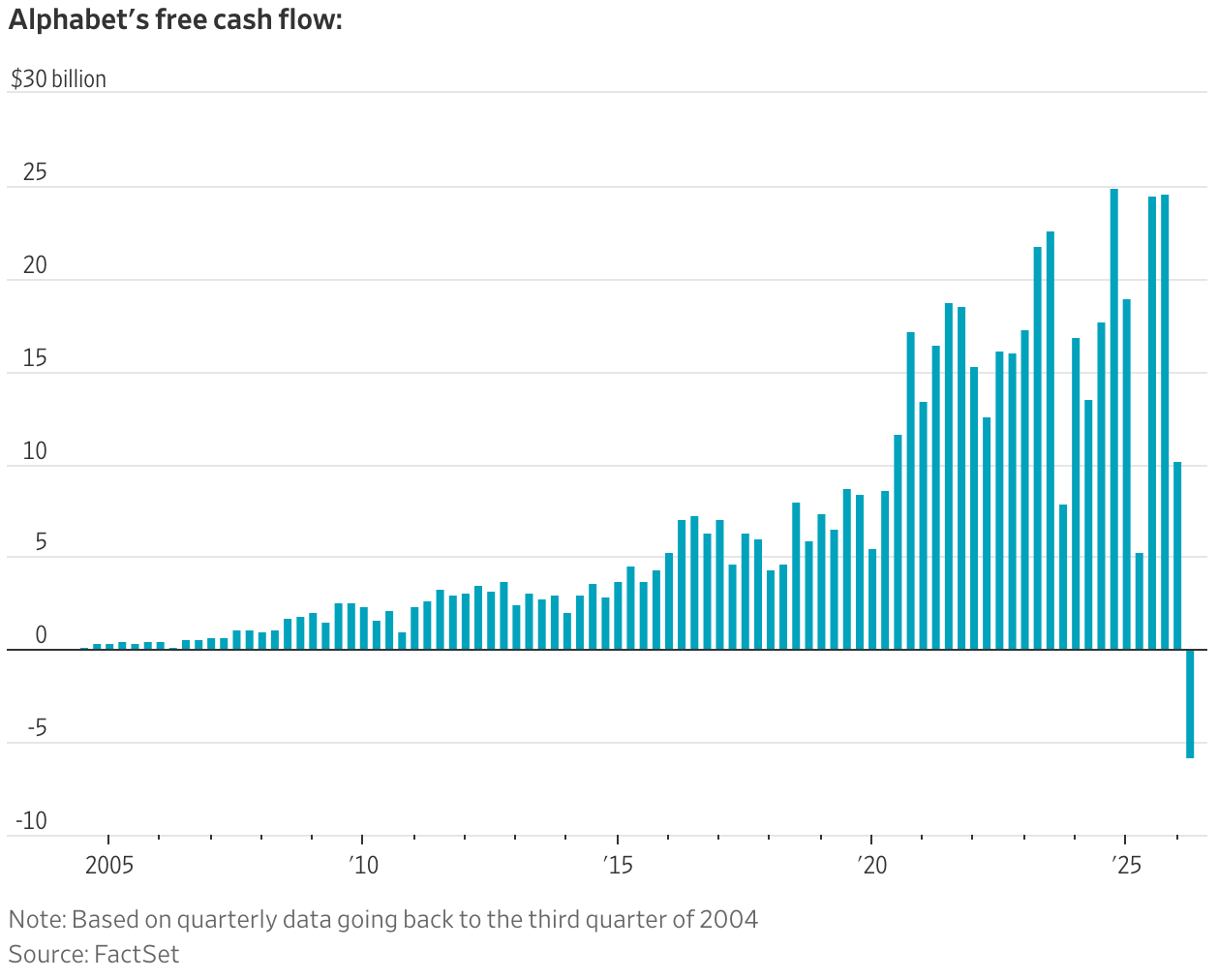
- 🔠 Alphabet is Now Negative Free Cash Flow – Alphabet is on the other end of the spectrum from Apple, spending lots to gain an AI advantage:
- “Alphabet’s free cash flow came in at negative $5.9 billion—the first negative print since the company went public in 2004. Its finance chief said free cash flow would remain under pressure as the company deepens its investments in AI. Alphabet also lifted its capital spending forecast to as much as $205 billion this year.” — Hannah Erin Lang, Tina Li, and Caitlin McCabe, The Wall Street Journal
- Free cash flow is essentially the money companies have left over after expenses and investments. It details how much cash is available for things investors like, such as dividends and share repurchases.
- Tesla and Amazon are also in this camp (with Meta approaching), spending lots to gain a future advantage. The fact that their stocks are being penalized for this spending to me suggests that investors are getting impatient. This is also not the behavior you’d expect in a bubble environment (which some people claim we’re in).
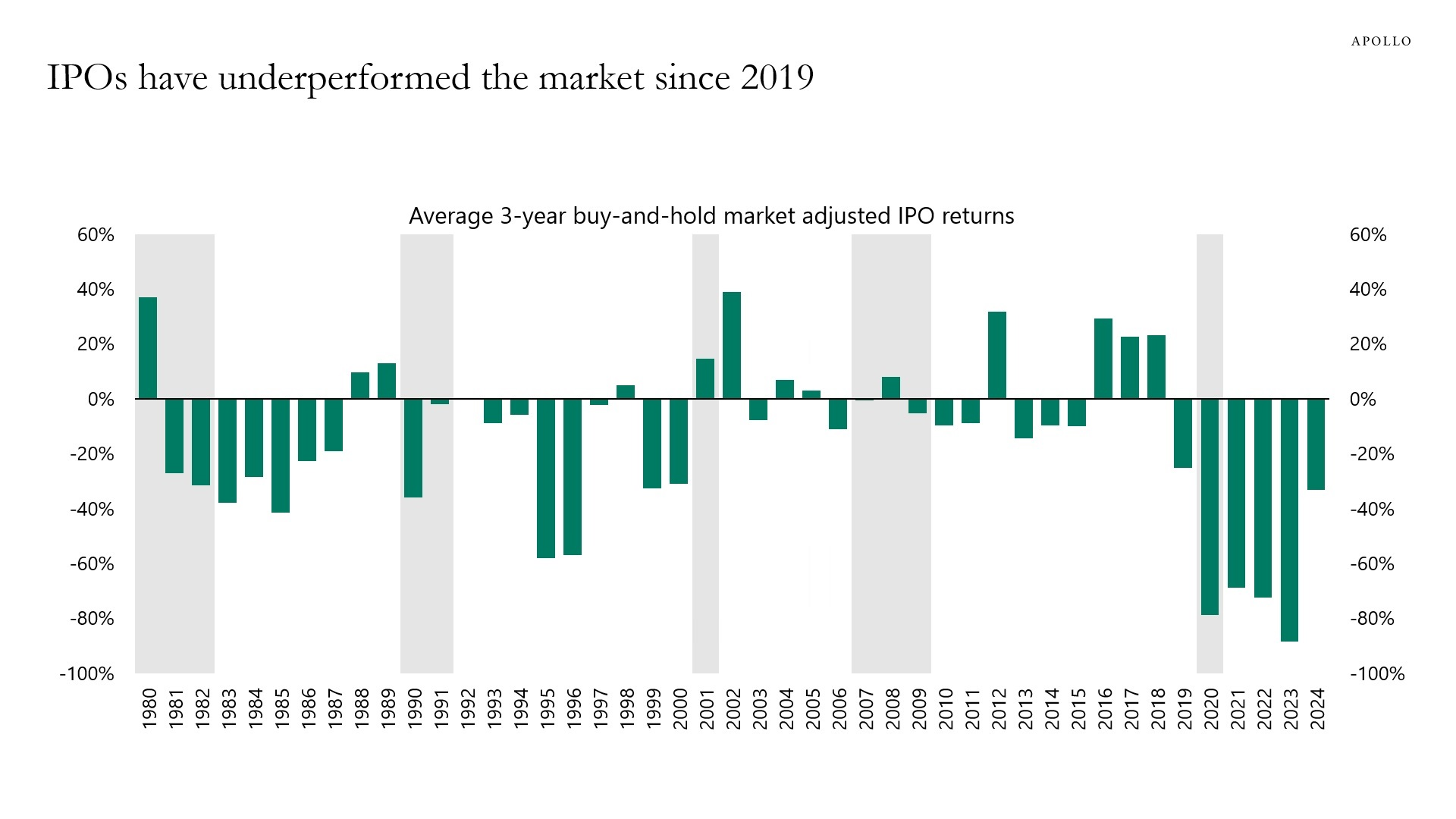
- 😬 IPOs Have Been a Losing Bet Since 2019 – “IPOs since 2019 have underperformed the broader market over the following three years.” — Torsten Slok, Chief Economist, Apollo
- This is perhaps an indictment of the venture capitalists and private markets. It seems that companies are repeatedly overvalued prior to going public.
Interesting Stats
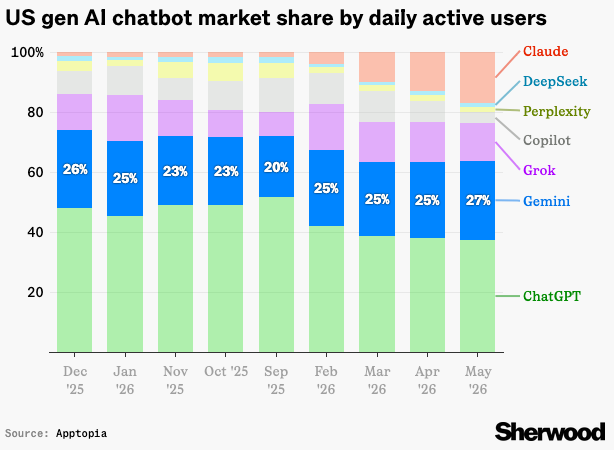
- 💬 Chatbot Market Share – Claude looks to have the momentum, but GPT still has the biggest market share:
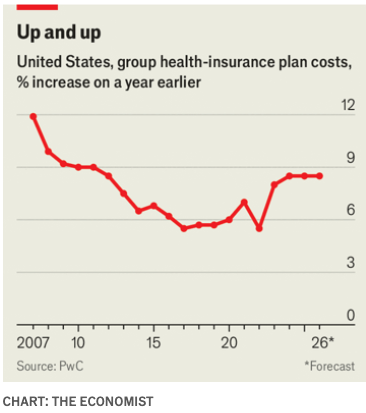
- 🏥 Healthcare Inflation – Unfortunately, health insurance costs are likely headed higher.
- This is driven by a few factors: Government subsidies expiring, hospital consolidation, and increased use of medical care by the overall public.
- Annual healthcare inflation has rarely been below 6%! Much higher than the 2-3% overall inflation rate.
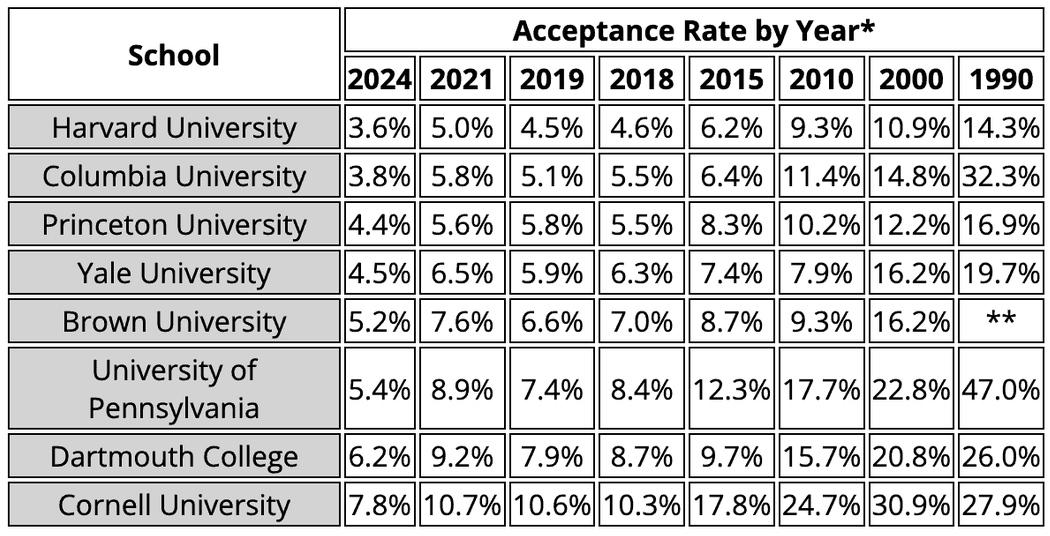
- 🏫 Ivy League Acceptance Rates – “Since 2015, the number of college applicants has gone up 78% while acceptance rates at elite colleges have plummeted” — Nick Maggiulli
- 👶 Trump Accounts – If you have a baby born between 2025 and 2028, they’re now eligible for a free $1,000 from the federal government.
- The child can’t access the money until they’re age 18, after which these accounts are treated like an IRA, where withdrawals are taxed at the child’s ordinary income tax rates.
- To learn more, click here or download the Trump Accounts app from the Apple App Store or Google Play.
- To receive the one-time $1,000 federal contribution, an authorized adult must open a Trump Account for the child and elect the pilot-program contribution on IRS Form 4547. The easiest route is to sign in to an IRS Individual Online Account through ID.me, submit Form 4547, and check the box requesting the $1,000 contribution.
Quote of the Month
“Do not let your actions be based on your fears.”
– Alice Crowe, the mother of Cameron Crowe, from the excellent book, The Uncool
I hope you found these interesting.
As always, please reach out if you have any questions or would like to connect.