Newsletter: The 3-1-1

Newsletter: The 3-1-1

Thank you for reading The 3-1-1, a bi-weekly newsletter about personal finance.

Please see this week’s articles, chart, and quote below:

3 Articles

Market Timing Game
Personal Finance Club

Are stocks due for a crash? Is it a good time to buy low? Can you time and beat the market? This simple game simulates the difficulty of timing the stock market.

How to Teach Your Kids the Value of Money
Michael Batnick, The Irrelevant Investor

People of affluence have to manufacture scarcity.

How to Unlock the Equity in Your Homes
Daniel Bortz, The New York Times

With the values of homes surging, U.S. homeowners have record amounts of equity available to them. Here are a few ways to cash in.

1 Chart

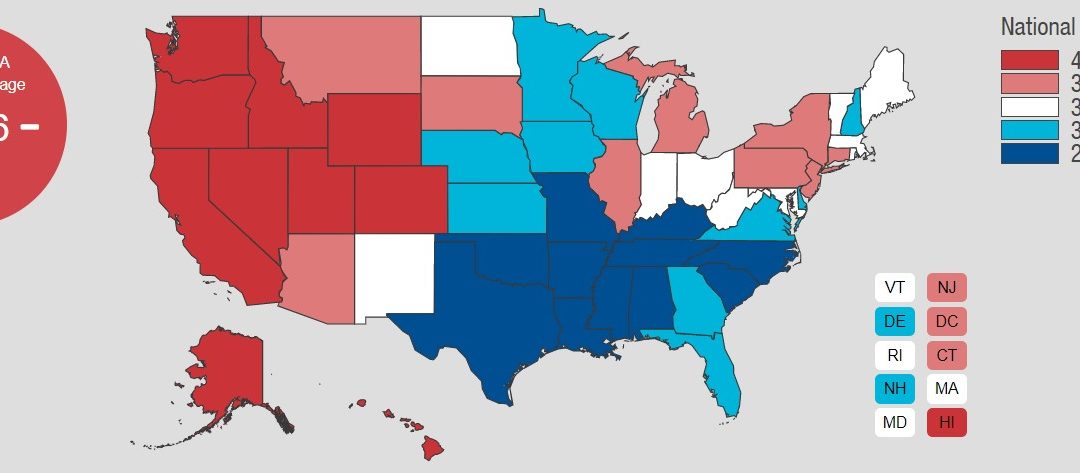
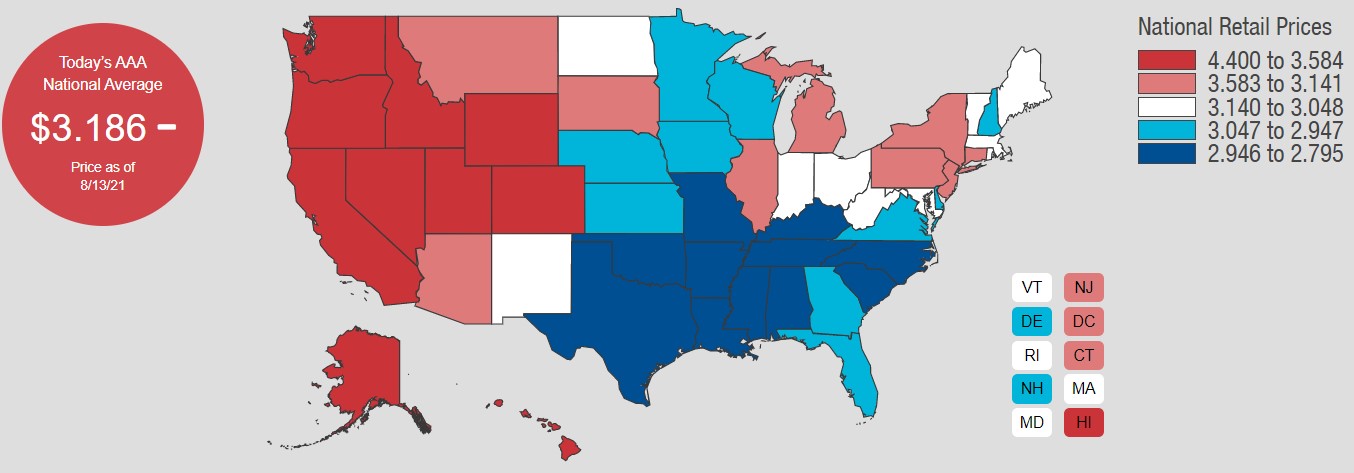
The national average for a gallon of regular gasoline is $3.18. AAA expects the national average to remain above $3 per gallon throughout the summer.
    1 Quote

    “One investment strategy that has proved to be a terrible one is believing that you can time the market.”

    – Scott Galloway

      Subscribe

      Join Our Newsletter

      Sign up to receive an email when new articles are posted.
      Disclosure: The information being provided is strictly as a courtesy/convenience. When you link to any of the web sites provided here, you are leaving this website. We make no representation as to the completeness or accuracy of information provided at these websites.
      Think Different Financial Planning is not liable for any direct or indirect technical or system issues or any consequences arising out of your access to or your use of third-party technology, web sites, information and programs made available through this website.
      When you access one of these web sites, you are leaving this web site and assume total responsibility and risk for use of the web sites you are visiting.
      Think Different Financial Planning does not make any representations or warranties as to the accuracy, timeliness, suitability, completeness, or relevance of any information prepared by any unaffiliated third party, whether linked to Think Different Financial Planning’s web site or incorporated herein, and takes no responsibility thereof.
      Newsletter: The 3-1-1

      Newsletter: The 3-1-1

      Please see this week’s personal finance articles, chart, and quote below.

      3 Articles

      Home Bias and the Best Time to Diversfiy
      Charlie Bilello, Compound Advisors

      An important article showcasing how investors are more comfortable owning stocks that are based in their own country.

      The Practicality of Money
      Aaron Tang, Mr. Stingy

      A lot of money advice sucks, not because it’s wrong, but because it’s impractical. It’s also near impossible to give one-size-fits-all advice.

      Why Renting Is Sometimes Smarter Than Buying
      Chris Hutchins, Wealthfront

      If you’re still renting and are experiencing FOMO, here are some things to think through before you jump on the buying bandwagon.

      Bonus Articles by Will

      Bay Area Real Estate Report: Santa Clara County, San Mateo County, & San Francisco County

      A look at the local real estate market for single family homes. In short, inventory is way down and demand is up, leading to a strong rise in prices over the past year:

      Investment Commentary – Second Quarter, 2021

      While the early impacts of COVID have certainly not disappeared, the second quarter in many ways marked a transition.

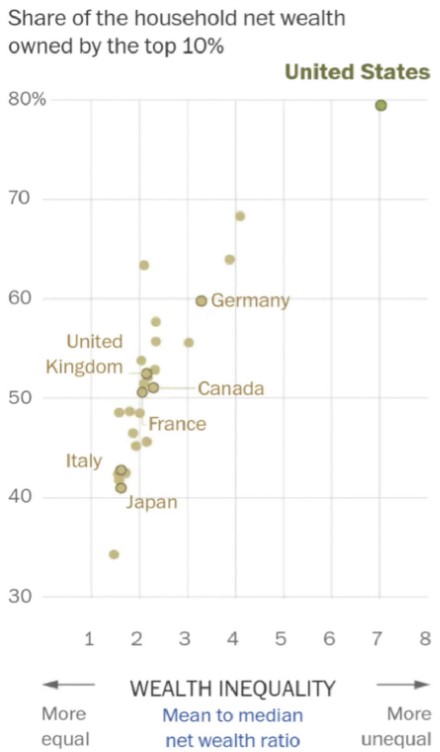
        1 Chart

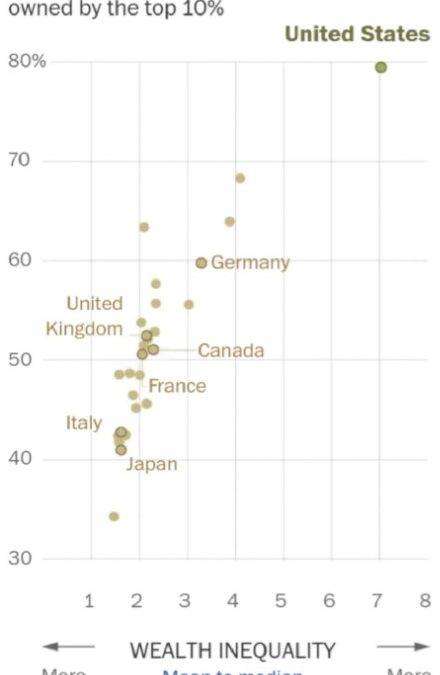
        In the United States the top 10% hold approximately 80% of the wealth. As compared to other developed countries, that distribution stands out:

          1 Quote

          “Too many people spend money they earned….to buy things they don’t want…to impress people that they don’t like.”

          – Will Rogers

            Subscribe

            Join Our Newsletter

            Sign up to receive an email when new articles are posted.
            Disclosure: The information being provided is strictly as a courtesy/convenience. When you link to any of the web sites provided here, you are leaving this website. We make no representation as to the completeness or accuracy of information provided at these websites.
            Think Different Financial Planning is not liable for any direct or indirect technical or system issues or any consequences arising out of your access to or your use of third-party technology, web sites, information and programs made available through this website.
            When you access one of these web sites, you are leaving this web site and assume total responsibility and risk for use of the web sites you are visiting.
            Think Different Financial Planning does not make any representations or warranties as to the accuracy, timeliness, suitability, completeness, or relevance of any information prepared by any unaffiliated third party, whether linked to Think Different Financial Planning’s web site or incorporated herein, and takes no responsibility thereof.
            Bay Area Real Estate Report: Santa Clara County, San Mateo County, & San Francisco County

            Bay Area Real Estate Report: Santa Clara County, San Mateo County, & San Francisco County

            Introduction
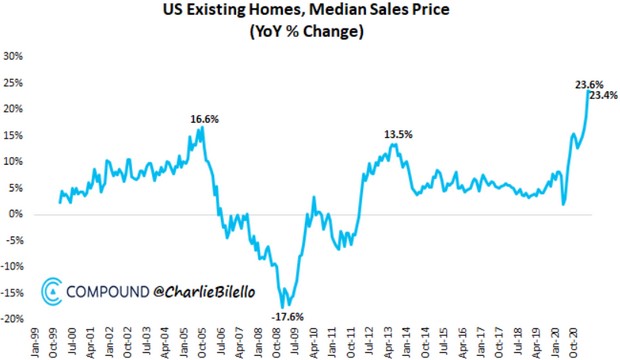
            If you knew that a global pandemic and recession were coming in early 2020, you probably would have thought that real estate prices would decline. To the surprise of many, the exact opposite happened.

            Nationwide home prices increased 23.4% over the past year. That’s nearly the highest increase on record, second only to May, 2021:

            Real estate across the country has done phenomenally well. But how has the unique Bay Area market done in comparison?

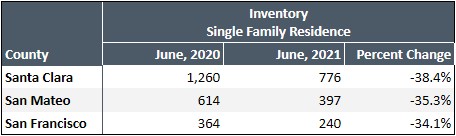
            In this summary we’ll review the two most important factors driving real estate: supply and demand. The data is through June, 2021, and reviews statistics related to single family homes in Santa Clara County, San Mateo County, and San Francisco County.

            Supply
            As compared to a year ago, housing inventory, which measures supply, has plummeted:

            Demand
            With the stock market at all-time highs and many Bay Area companies going public, getting purchased, or getting funding, many employees in technology are wealthier than ever before.

            This has led to an increase in demand for single-family homes, which have become more sought after as a result of the pandemic.

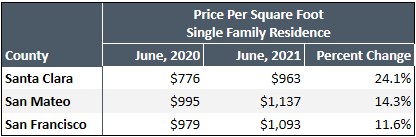
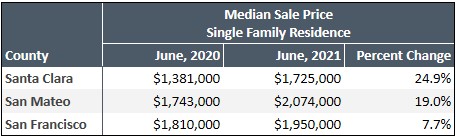
            Over the past year, prices have appreciated nearly 25% in Santa Clara County, 19% in San Mateo County, and almost 8% in San Francisco County:

            Price per square foot is also on the rise:

            Conclusion
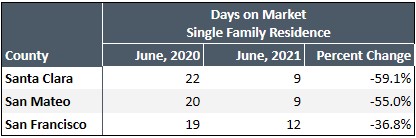
            The limited supply and influx of demand has led homes to selling faster than ever. A year ago, homes in these counties would sell in approximately three weeks. That timeline has declined markedly across the board:

            It has never been easy or cheap to purchase a home in these counties, but over the past year it has become even harder. While it’s unclear if these trends will continue, the one thing that is clear is this: it’s a seller’s market.

            Subscribe

            Join Our Newsletter

            Sign up to receive an email when new articles are posted.
            Disclaimer: The opinions expressed in this article are for general informational purposes only and are not intended to provide specific advice or recommendations for any individual or on any specific security. The material is presented solely for information purposes and has been gathered from sources believed to be reliable, however Think Different Financial Planning cannot guarantee the accuracy or completeness of such information, and certain information presented here may have been condensed or summarized from its original source. Think Different Financial Planning does not provide tax or legal advice, and nothing contained in these materials should be taken as such. As always please remember investing involves risk and possible loss of principal capital. Advisory services are only offered to clients or prospective clients where Think Different Financial Planning and its representatives are properly licensed or exempt from licensure. No advice may be rendered by Think Different Financial Planning unless a client service agreement is in place.Your content goes here. Edit or remove this text inline or in the module Content settings. You can also style every aspect of this content in the module Design settings and even apply custom CSS to this text in the module Advanced settings.

            Investment Commentary, Q2 2021

            Investment Commentary, Q2 2021

            Highlights
            While the impacts of COVID have certainly not disappeared, the second quarter in many ways marked a transition. With economic reopening and many people returning to “normal” activities, economic activity and employment have picked up meaningfully, along with inflation.

            Yet, many of these statistics are being biased by what is known as the “base effect.” They are often being measured year-over-year relative to suppressed values during the early parts of COVID crises. We see this effect both in economic statistics, as well as trailing returns looking back over the last year.

            The Federal Reserve and other global central banks continue to remain accommodative. The Fed has kept short-term rates unchanged, and indicate their analysis shows the current inflation levels are likely to be transitory in nature. They have communicated their intent to maintain their stance and evaluate new data, as they seek to fulfill their mandate to promote maximum employment and stable prices.

            Second Quarter Market Summary
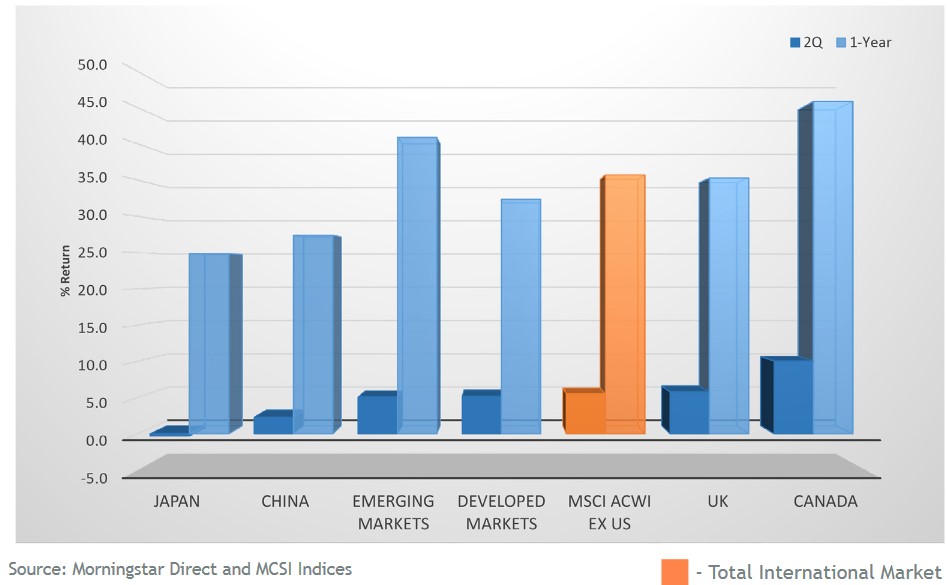
            Stock market returns were positive across all major geographies. The US generated the strongest gains, while international developed and emerging markets also advanced.

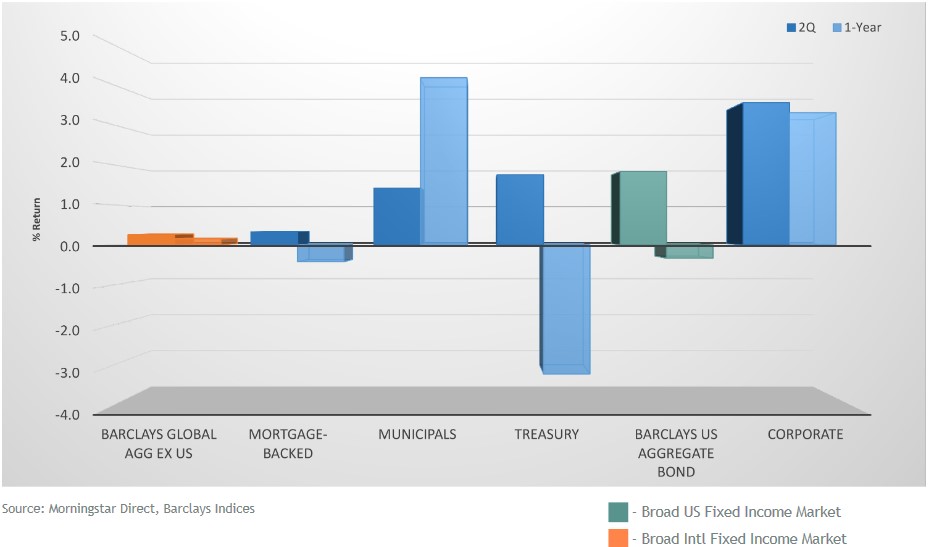
            After facing headwinds during the first quarter, bond returns were also positive during the second the quarter. Intermediate and longer-term interest rates have pulled back modestly after peaking in March, while short-term rates have remained unchanged

            US Stocks
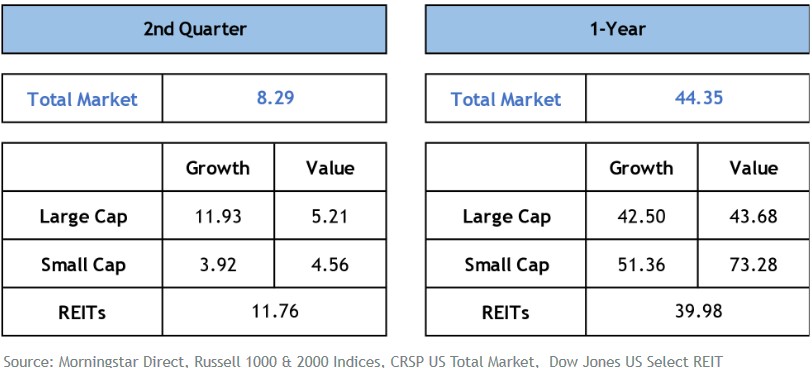
            The US stock market appreciated nearly 8.3% during the 2nd Quarter, and 44.3% over the past year. While value and smaller cap names had a strong run over the prior two quarters, large cap growth showed strength during the quarter. Small cap, and in particular small cap value, has meaningfully outpaced other styles over the past 12 months. Real estate investment trusts (REITs) performed well during the quarter, while modestly trailing the broader equity market over the last year.

            International Stocks
            International stocks also gained during the quarter, appreciating 5.2% and 5.1% for developed and emerging markets, respectively. Over the past year, emerging markets have returned 40.9%, outpacing the 32.4% gain for developed markets.

            While vaccination rates vary widely across the globe, progress continues, and many major economies are rebounding along with the United States. Absolute returns across all areas have been strong over the last year, with Canada and emerging markets standing out as particular areas of strength.

            Bonds
            Rebounding from the first quarter, returns were also positive across investment grade fixed income sectors during the second quarter. While the short end of the yield curve remains near zero, intermediate and long-term interest rates have generally declined after peaking in March. Municipals and corporate bonds have been the strongest performers over the past year. After being the top sector during the market sell-off last year, treasuries have pulled back since. Both the Aggregate Bond Index (U.S.) and the Global Aggregate ex-US Index (international) have been essentially flat over the last year.

            Parting Thoughts
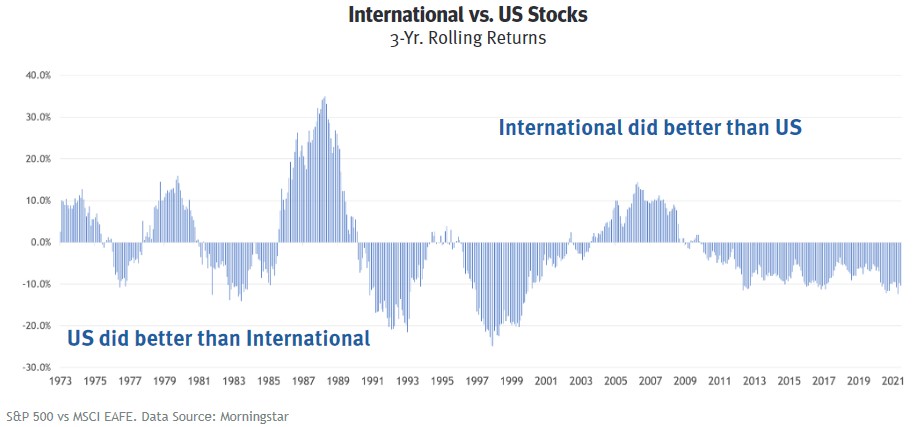
            This quarter, we wanted to revisit the importance of global diversification. We know from history that the US and international stock markets trade off leadership over various time periods. When looking at rolling 3-year periods, the US has now outperformed international equities for the last 139 periods (more than decade). Given the length of this streak, investors may question the need to diversify their assets globally. Historically, US and non-US stocks have outperformed each other in cycles that are impossible to predict.

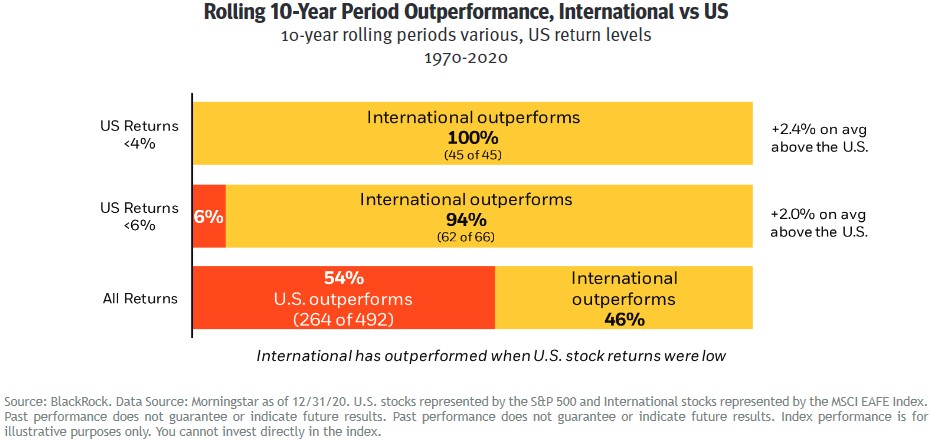
            BlackRock, in their Student of the Markets publication, researched deeper into the periods when international stocks outperform. Since 1970, the US market has a slight edge, outperforming 54% of the time. However, BlackRock found that international stocks have tended to outperform during periods when US stock market returns were lower than average. In fact, their research showed that international outperformed in 45 out of 45 ten-year rolling periods where US returns were less than 4%, and 94% of the time when US returns were less than 6%.

            While we know predicting the stock market or timing changes in market leadership is a futile task, given current high valuations for US stocks, it is reasonable to expect returns going forward to be lower than their historical average. If so, the data is clear that international stocks offer a strong ability to add value to portfolios.

            Subscribe

            Join Our Newsletter

            Sign up to receive an email when new articles are posted.

            Disclaimer: The opinions expressed in this article are for general informational purposes only and are not intended to provide specific advice or recommendations for any individual or on any specific security. The material is presented solely for information purposes and has been gathered from sources believed to be reliable, however Think Different Financial Planning cannot guarantee the accuracy or completeness of such information, and certain information presented here may have been condensed or summarized from its original source. Think Different Financial Planning does not provide tax or legal advice, and nothing contained in these materials should be taken as such. As always please remember investing involves risk and possible loss of principal capital. Advisory services are only offered to clients or prospective clients where Think Different Financial Planning and its representatives are properly licensed or exempt from licensure. No advice may be rendered by Think Different Financial Planning unless a client service agreement is in place.Your content goes here. Edit or remove this text inline or in the module Content settings. You can also style every aspect of this content in the module Design settings and even apply custom CSS to this text in the module Advanced settings.

            Weekly Newsletter: The 3-1-1

            Weekly Newsletter: The 3-1-1

            I hope you’re doing well and having a great week!

            Last week I was on a road trip around the Mountain West and was unable to send The 3-1-1. I visited Portland, Seattle, Missoula, Jackson Hole, Park City, and Lake Tahoe. Some of these areas were completely new to me, and after a travel-free 2020 it reminded how much I miss the travel experience.

            And now, back to our regularly scheduled content. Please see this week’s personal finance articles, chart, and quote below.

            3 Articles

            Should You Buy at an All-Time High
            Nick Maggiulli, Of Dollars and Data

            A data-backed article detailing why all-time highs in the stock market are, surprisingly, a bullish indicator.

            Rent Prices Are Soaring As Americans Flock Back to Cities
            Heather Long, The Washington Post

            Nationwide rent prices are up 7.5% so far this year, three times higher than normal.

            The 10 Best Personal Finance Podcasts to Listen to in 2021
            Mike Winters, lifehacker

            1 Chart

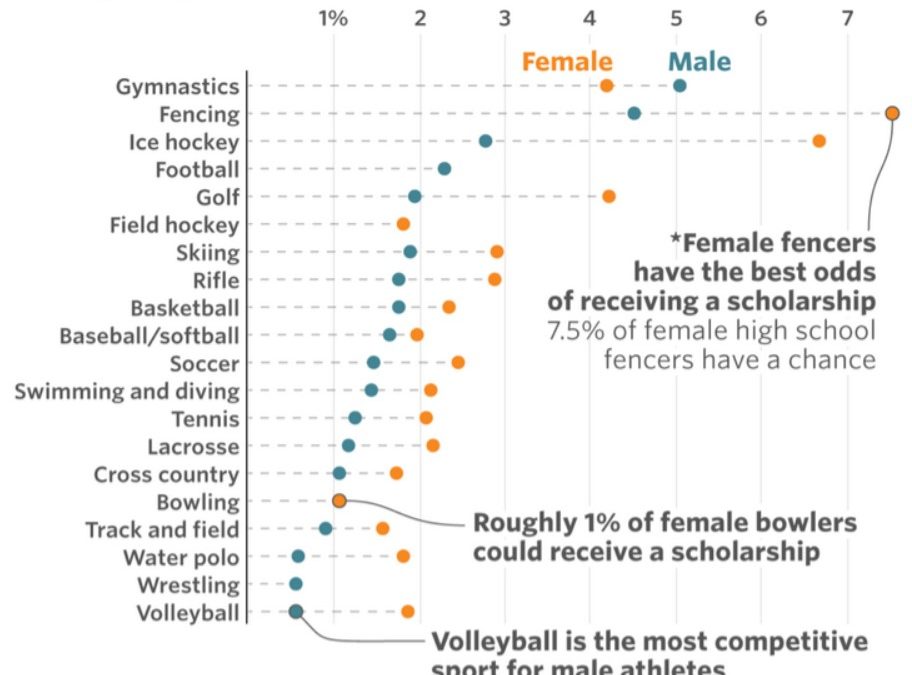
            For the parents out there, you might be interested to know which sport offers the best chance of a college scholarship:

              Source: Understanding The Harsh Reality Of Athletic Scholarships, Tony Isola, A Teachable Moment

                1 Quote

                “The root of all evil isn’t money; rather, it’s not having enough money.”

                – Gene Simmons

                  Subscribe

                  Join Our Newsletter

                  Sign up to receive an email when new articles are posted.
                  Disclosure: The information being provided is strictly as a courtesy/convenience. When you link to any of the web sites provided here, you are leaving this website. We make no representation as to the completeness or accuracy of information provided at these websites.
                  Think Different Financial Planning is not liable for any direct or indirect technical or system issues or any consequences arising out of your access to or your use of third-party technology, web sites, information and programs made available through this website.
                  When you access one of these web sites, you are leaving this web site and assume total responsibility and risk for use of the web sites you are visiting.
                  Think Different Financial Planning does not make any representations or warranties as to the accuracy, timeliness, suitability, completeness, or relevance of any information prepared by any unaffiliated third party, whether linked to Think Different Financial Planning’s web site or incorporated herein, and takes no responsibility thereof.
                  What Happens If I Save Too Much in a 529?

                  What Happens If I Save Too Much in a 529?

                  Many parents save for their child’s college education using a 529 account. But what happens if you “over-fund” the account and save too much?

                  If you are lucky enough to have this problem, you have three options:

                  1. Reassign: You can reassign the 529 account to a direct relative without any tax consequences. This includes nieces, nephews, cousins, aunts, uncles, or even yourself, for future education goals.
                  2. Withdraw It (and Pay the Penalty): If you withdraw the money for non-educational purposes, you’ll pay state and federal income tax on the gain, as well as a 10% penalty (+ a 2.5% if you live in California). Non-qualified distributions payable to the beneficiary (the child) are taxed at the beneficiary’s tax rate. Non-qualified distributions payable to the parent are taxed at the parent’s ordinary income rate.
                  3. Save It: By not withdrawing the money, you allow the investments to grow tax free. You can then withdraw the money in a lower-income year. Alternatively, the money can be left alone for the child’s graduate school or a future grandchild’s education costs.

                  The takeaway is that there isn’t a penalty for leaving extra money in a 529 plan after a student graduates.

                  Subscribe

                  Join Our Newsletter

                  Sign up to receive an email when new articles are posted.
                  The information, analysis, and opinions expressed herein are for general and educational purposes only. Nothing contained in this commentary is intended to constitute legal, tax, accounting, securities, or investment advice, nor an opinion regarding the appropriateness of any investment, nor a solicitation of any type. The material has been gathered from sources believed to be reliable, however Think Different Financial Planning cannot guarantee the accuracy or completeness of such information, and certain information presented here may have been condensed or summarized from its original source. All opinions and views constitute our judgments as of the date of writing and are subject to change at any time without notice.