
September Market Update

September Market Update

I hope you had a wonderful Summer and are looking forward to Fall

If you’ve been preoccupied with the investment world (which I hope you haven’t!), you may have noticed that volatility is back.

Given that, I wanted to showcase some of the good news, some of the bad news, and provide my take on the current investment environment.

The Good News

  • Social Security payments may rise by 8-9% in 2023. This would be a meaningful increase to everyone who is receiving Social Security now or will in the future.
  • Bonds and bank accounts are starting to pay meaningful interest.
  • Gas prices have declined for 89 consecutive days (as of Sept. 12th).
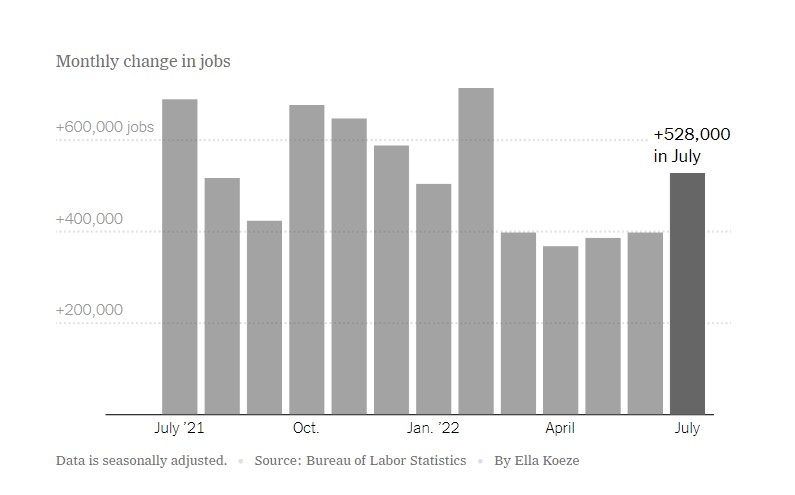
  • The job market remains very strong.
  • The revenue (i.e., sales) of companies in the S&P 500 Index – perhaps the most important metric for a company – are the highest they’ve ever been.

The Bad News

The majority of this year’s bad news stems from the rise in interest rates. The increase, which is a policy response to high inflation, has effected almost everything in finance:

Real Estate

  • Mortgage rates have doubled over the past year and are now above 6%.
  • High mortgage rates are starting to impact the housing market. Demand for new homes seems to be cooling, as mortgage purchase applications are down 23% from a year ago.
  • Prices recently declined in the following 7 cities: San Francisco, San Diego, Los Angeles, Seattle, Portland, Denver, and Washington D.C.

 Inflation

  • Inflation remains high in many areas: In the US it’s 8.3%, in the Eurozone it’s 9.1%, and in the UK it’s 9.9%. The inflation in Europe is largely driven by energy prices, which may be the catalyst for a European recession.

Stocks

  • The global stock market is down approximately 20% from its high in January.

Bonds

  • Bonds have not declined as much as stocks, but they’re still down around 13% for the year, a much bigger decline than bond investors are used to.

My Take

I can’t say it any better than financial blogger Ben Carlson:

“If you’re an accumulator of financial assets, this volatility should  be viewed as an opportunity to buy at lower prices, not a risk. If you’ve already accumulated financial assets, this volatility is on the other side of a decade-plus of extraordinary gains in the U.S. stock  market. Either way, it’s important to remember that volatility — to both the upside and the downside — is a feature of bear markets.”

As for the “what to do” now question, I’m reminded of another quote from famed investor Peter Lynch:

“Far more money has been lost by investors preparing for corrections, or trying to anticipate corrections, than has been lost in corrections themselves.”

The investment approach utilized by Think Different Financial Planning is long term-oriented and emphasizes controlling what you can: your fees, the taxes related to your investments, and your portfolio risk. We’re extremely diversified and know that declines are a part of investing.

While there is a lot of bad news, in order to be a successful investor you have to invest like an optimist. We’ve persevered through worse before, and I believe we will again.

Subscribe

Join Our Newsletter

Sign up to receive an email when new articles are posted.

Disclaimer: Investments are not guaranteed and are subject to investment risk, including possible loss of the principal amount invested. Past performance is no guarantee of future results. All allocations and opinions expressed are as of the date of this presentation and subject to change. The information contained herein does not constitute investment advice or a solicitation. Information obtained from 3rd parties is believed to be accurate, but has not been independently verified.

The opinions expressed in this article are for general informational purposes only and are not intended to provide specific advice or recommendations for any individual or on any specific security. The material is presented solely for information purposes and has been gathered from sources believed to be reliable, however Think Different Financial Planning cannot guarantee the accuracy or completeness of such information, and certain information presented here may have been condensed or summarized from its original source. Think Different Financial Planning does not provide tax or legal advice, and nothing contained in these materials should be taken as such. As always please remember investing involves risk and possible loss of principal capital. Advisory services are only offered to clients or prospective clients where Think Different Financial Planning and its representatives are properly licensed or exempt from licensure. No advice may be rendered by Think Different Financial Planning unless a client service agreement is in place.
August Update: The Good News & Bad News About Our Economy

August Update: The Good News & Bad News About Our Economy

There has been a lot of news lately about the possibility of a recession. The economic data has been evolving over the past few months, so I wanted to help break it down.

I’ll start by sharing some of the good news, followed by some of the bad news, and then my take.

The Good News

  • Inflation may be declining: Recent data shows inflation growing at 8.5% per year. It was previously growing at 9.1% per year.
  • Gas prices are down about $1 per gallon, or 20%, from their high in June.
  • The unemployment rate is at a 50-year low of 3.5%.
  • We’ve recovered all the jobs lost during the pandemic.
  • Home prices hit a record high for the 40th month in a row. They are up 20% over the last year and 40% over the past two years (through May, the most recent data available).
  • Company Earnings are strong: Over half the S&P 500 has now reported second-quarter earnings. Three in four have beaten earnings estimates.
  • Savings accounts are finally paying meaningful interest. You can earn over 1.50% at a number of banks. Plus, Inflation Bonds are still paying 9.62%. 

The Bad News

  • America’s inflation-adjusted Gross Domestic Product has declined for two straight quarters.
  • Only 10% of people feel positive about the economy.
  • Inflation is still near a four-decade high.
  • Housing activity may be declining. Prices in San Francisco are down 8% from a year ago. Mortgage applications to purchase a home dropped 19% compared to a year ago.
  • The war in Ukraine is ongoing, and tensions with China are rising.
  • Despite a good start to this quarter, stocks and bonds remain negative year-to-date. Unprofitable technology companies, in particular, are down 61%.

My Take

There is a saying that stocks “climb a wall of worry.”  When it comes to investing, there is always something to worry about. Yet in the face of these persistent and ever-present risks, stocks (and bonds) have provided positive long-term returns. If there was no risk, there would be no return.

I think The New York Times summarized our current situation well: “If the United States is headed into a recession, it is taking an unusual route, with many markers of a boom.” While a recession could occur later this year, or next year, or even the following year, for now the positive news outweighs the negative.

Subscribe

Join Our Newsletter

Sign up to receive an email when new articles are posted.

Disclaimer: Investments are not guaranteed and are subject to investment risk, including possible loss of the principal amount invested. Past performance is no guarantee of future results. All allocations and opinions expressed are as of the date of this presentation and subject to change. The information contained herein does not constitute investment advice or a solicitation. Information obtained from 3rd parties is believed to be accurate, but has not been independently verified.

The opinions expressed in this article are for general informational purposes only and are not intended to provide specific advice or recommendations for any individual or on any specific security. The material is presented solely for information purposes and has been gathered from sources believed to be reliable, however Think Different Financial Planning cannot guarantee the accuracy or completeness of such information, and certain information presented here may have been condensed or summarized from its original source. Think Different Financial Planning does not provide tax or legal advice, and nothing contained in these materials should be taken as such. As always please remember investing involves risk and possible loss of principal capital. Advisory services are only offered to clients or prospective clients where Think Different Financial Planning and its representatives are properly licensed or exempt from licensure. No advice may be rendered by Think Different Financial Planning unless a client service agreement is in place.
Investment Commentary, Q2 2022

Investment Commentary, Q2 2022

Q2 Investment Commentary Highlights
Stocks and bonds, both in the US and abroad, experienced further volatility and declines during the second quarter of 2022. It is times like these that test us as investors. Look at a long-term chart of the stock market and you’ll see that it moves up and to the right. But in order to get those long-term results, you have to be able to survive the short- and medium-term declines like we’re in now.

The major factors driving the markets centered around inflation, strong policy responses from the Federal Reserve and other central banks, and the ongoing war in Ukraine. While stocks and bonds are often influenced by different factors and exhibit a low correlation to each other, the macro trends this year have presented headwinds for nearly all asset classes.

A variety of issues have contributed to inflation: the aforementioned war in Ukraine, COVID lockdowns in China, and continued supply chain challenges around the world. The Federal Reserve raised the Fed Funds rate 1.25% during Q2. Markets have also priced in expectations for further increases at the Fed’s next several meetings. The Federal Reserve remains committed to bringing inflation under control, which has led investors to also consider the probability of an increased risk of recession. However, on the positive side, the employment and job opening data remain very strong.

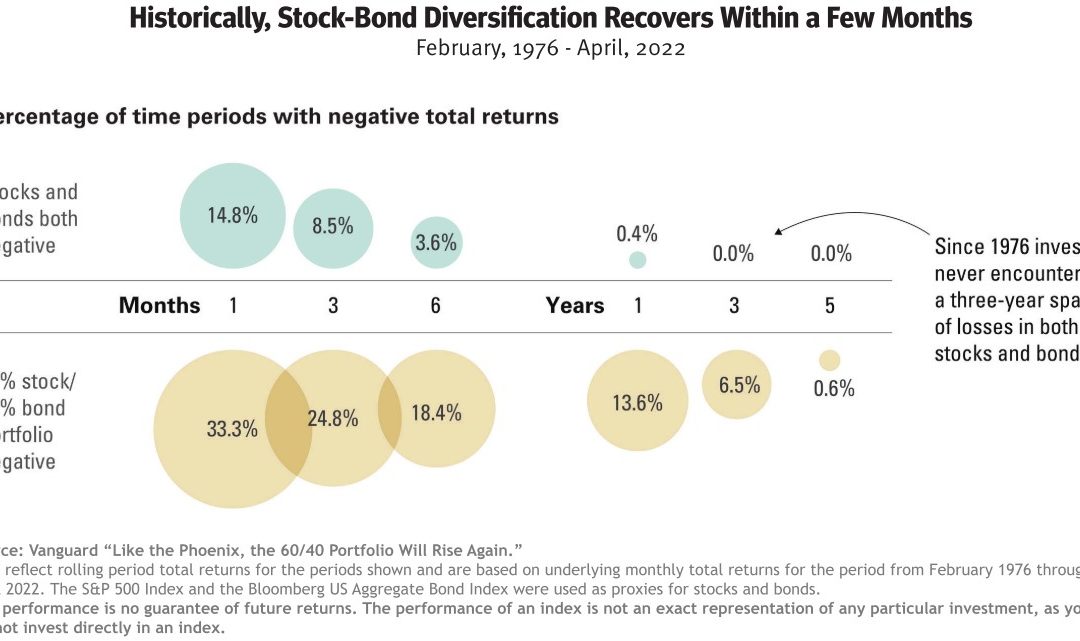
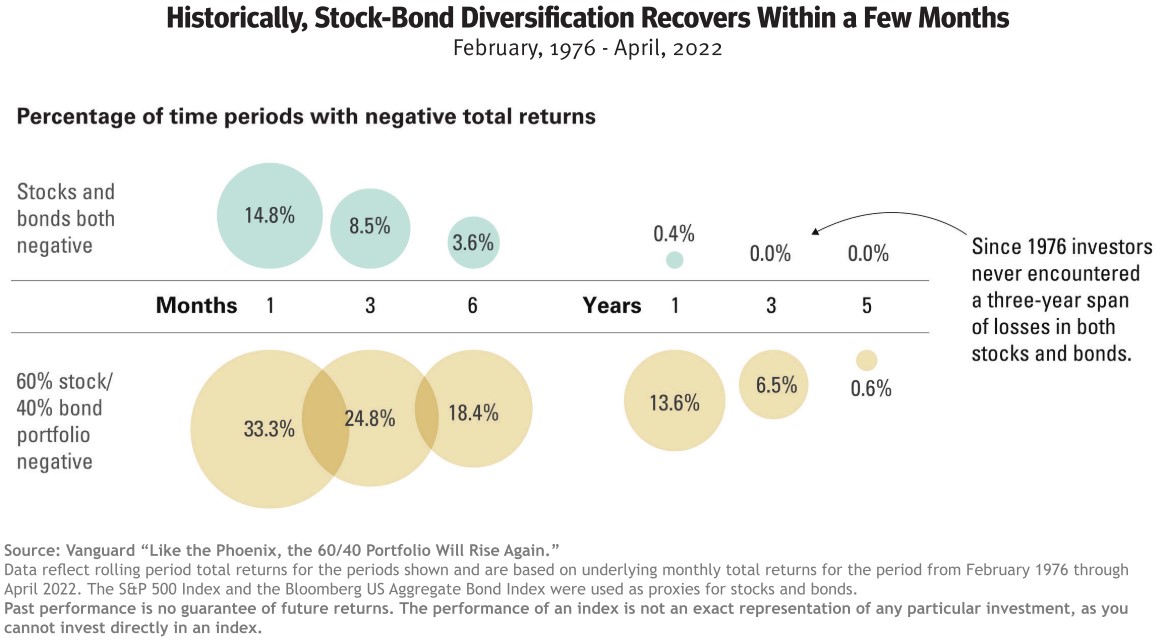
A little historical context on the current environment might be useful. While stocks and bonds are broadly considered to offer correlation and diversification benefits for investors over time, the first six months of 2022 have clearly highlighted, especially over the short-term, that it does not always hold true. The following illustration highlights that historically stocks and bonds have both fallen in about 15% of months (roughly 1 in 7 months). While not unprecedented, having stocks and bonds both down over a 6-month period is certainly a rarer event:

Over longer periods, the historical probability of negative outcomes for both stocks and bonds becomes significantly lower. In fact, Vanguard notes that since 1976, stocks and bonds have never both been negative over a 3-year time period.


While we know past performance does not guarantee us anything about the future, it is informative to understand the unique situation that investors have endured to start 2022. It is also important to consider the longer-term benefits of holding diversified, risk-appropriate portfolios for achieving investment goals.

Markets have shown their resilience through many business cycles, interest rate increases and decreases, expansions and recessions, and even periodic “black-swan” events like wars and pandemics. Although the current environment offers many short-term reasons for pessimism, and turbulent markets can certainly test our resolve, history has shown that long-term investors who stick to their plan and remain disciplined ultimately will be rewarded for their patience.

US Stocks
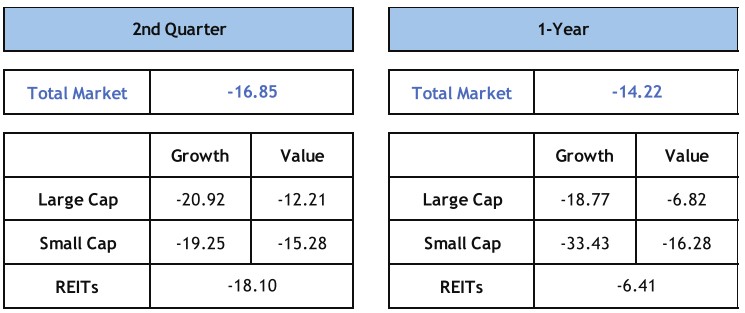
US stocks fell during the second quarter by -16.9%, and are down -14.2% over the past year. While in absolute terms it is certainly a meaningful decline, we must remember this has come following a very strong period for investors. Looking at the S&P 500, for example, prices are back to levels where they were roughly at the beginning of last year.

There has also been a distinct shift among investment styles, with value stocks outperforming more growth-oriented stocks (which tend to be more tech heavy). Growth stocks over the past year have been among the weakest areas.

International Stocks
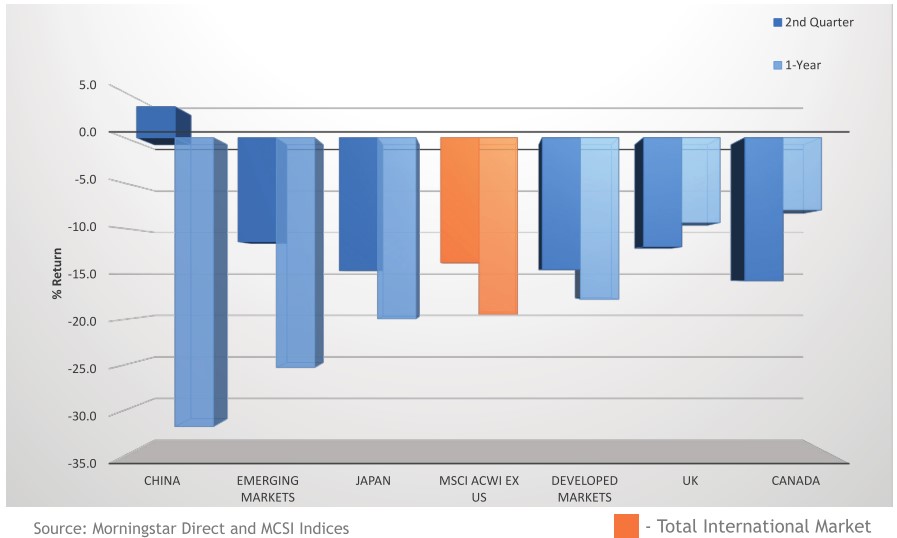
International developed markets finished the quarter down slightly less than US markets (-14.5%), while emerging market stocks held up relatively better than either (-11.5%).

While the current environment has provided very few places for shelter, after a strong sell-off earlier, one area of positive returns during the quarter came from China as many lockdowns were lifted and increased economic activity resumed. International stocks have trailed the US markets over the last year, with developed markets returning -17.8% and emerging markets declining -25.4%.

Bonds
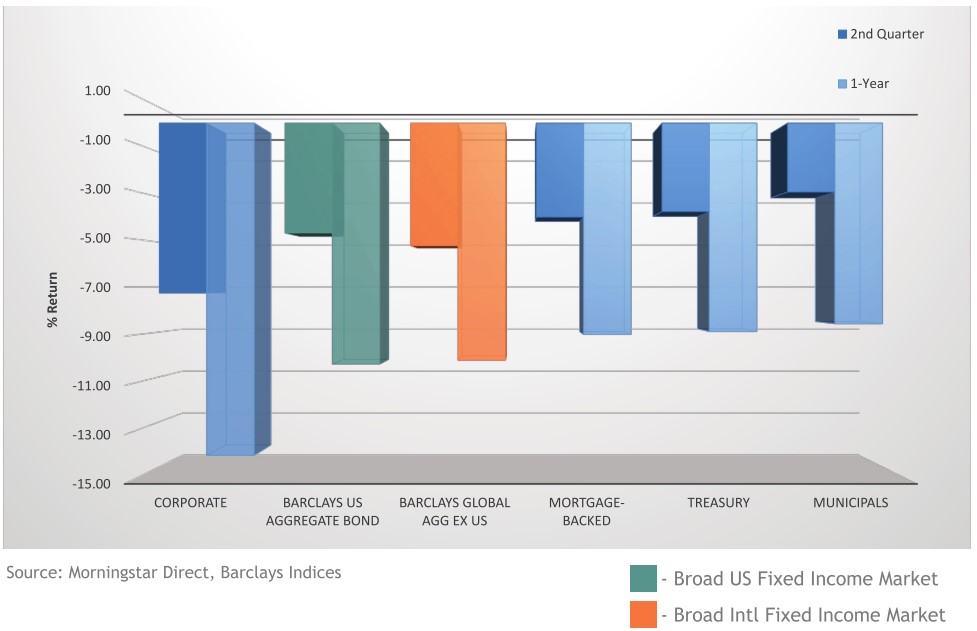
Bonds fell during the quarter, reflecting the repricing of expectations for interest rates and inflation. In addition to the impact of higher rates, credit spreads widened as investors demanded more compensation for the higher risk of corporate bonds relative to Treasuries. The result was that corporate bonds were among the weakest performers for the quarter and the last year.

One silver lining of the rise in interest rates is that going forward, fixed income investments offer a much more attractive return opportunity than has been available for quite some time. As bonds mature and coupon payments are received, they can be reinvested at higher rates. While challenging currently, over the longer term investors have the opportunity to benefit from higher returns than if rates had not moved at all and simply stayed at pre-2022 levels.

Subscribe

Join Our Newsletter

Sign up to receive an email when new articles are posted.

Disclaimer: Investments are not guaranteed and are subject to investment risk, including possible loss of the principal amount invested. Past performance is no guarantee of future results. All allocations and opinions expressed are as of the date of this presentation and subject to change. The information contained herein does not constitute investment advice or a solicitation. Information obtained from 3rd parties is believed to be accurate, but has not been independently verified.

The opinions expressed in this article are for general informational purposes only and are not intended to provide specific advice or recommendations for any individual or on any specific security. The material is presented solely for information purposes and has been gathered from sources believed to be reliable, however Think Different Financial Planning cannot guarantee the accuracy or completeness of such information, and certain information presented here may have been condensed or summarized from its original source. Think Different Financial Planning does not provide tax or legal advice, and nothing contained in these materials should be taken as such. As always please remember investing involves risk and possible loss of principal capital. Advisory services are only offered to clients or prospective clients where Think Different Financial Planning and its representatives are properly licensed or exempt from licensure. No advice may be rendered by Think Different Financial Planning unless a client service agreement is in place.Your content goes here. Edit or remove this text inline or in the module Content settings. You can also style every aspect of this content in the module Design settings and even apply custom CSS to this text in the module Advanced settings.

June Market Update

June Market Update

Overview

The US stock market is down 23% since the start of the year. Almost every investment around the world is negative: international stocks (-22%), US bonds (-15%), and international bonds (-12%). Less diversified investments, such as the technology-heavy NASDAQ index (-30%), are down even more (source). 

You may be wondering if these declines should cause you to rethink your investment approach. For a properly diversified investor with a long time horizon, the answer is no. Let me explain why through the following topics: the stock market, the bond market, investing during a potential recession, and the pitfalls of market timing. 

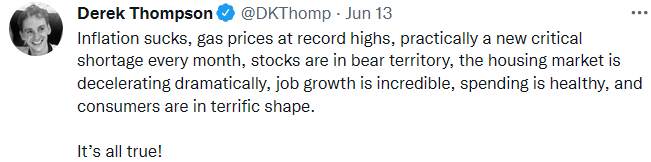
But first, a tweet that summarizes the good and the bad:

The Stock Market

As highlighted above, there are many worrying developments around the world: inflation, supply chain issues, the Russia-Ukraine war, gas prices, rising interest rates, and a potential recession. 

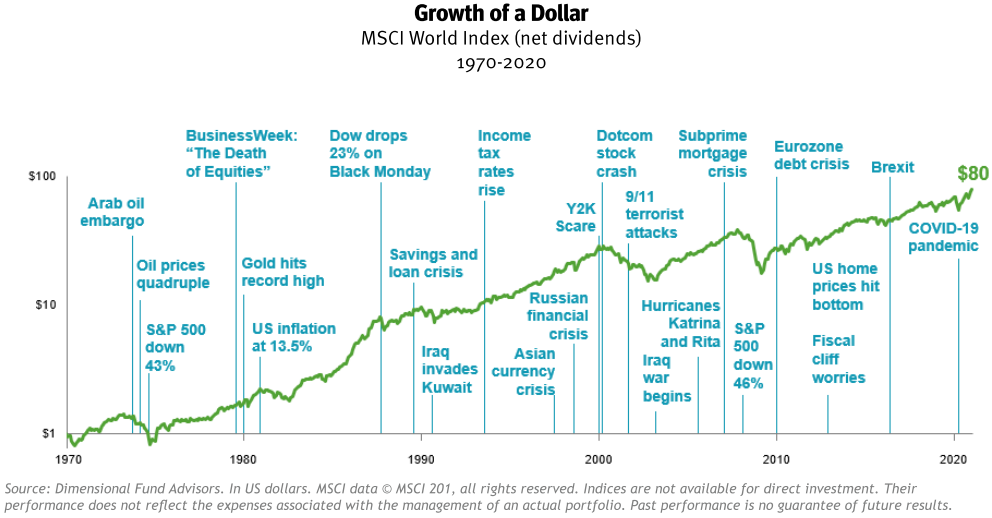
The chart below helps put things in perspective. It summarizes some of the worst headlines over the past 50 years as compared to the return of a global stock index. 

Since 1970 there have been seven recessions. As you’d expect, there was lots of awful news: 9/11, Black Monday (in which the Dow dropped 23% in one day), the Great Financial Crisis of 2008-09 (stocks dropped ~50%), and the Arab oil embargo of the 1970s, just to name a few. However, during these 50 years the stock market increased 80-fold, or about 9% per year:

“We will never be without problems, and some of them will be extremely serious problems. The point that this chart cries out to us – this endless chain of permanent advance punctuated by temporary decline – is that we bend, but we never break. And when we recover, we are more flexible, more resilient, more transparent, and more entrepreneurial than ever. The world does not end; it only appears to be ending from time to time…all previous crises – many far worse than today’s – have been successfully resolved.” 

– Nick Murray 

Unfortunately, the ride for investors isn’t smooth. If there was no risk to investing there’d be no return. With a “buy and hold” investment strategy, holding is the hardest part. That’s why an asset allocation that matches your risk tolerance is so important. 

There will continue to be ups and downs, but over time the market should be expected to rise, as it has in the past. 

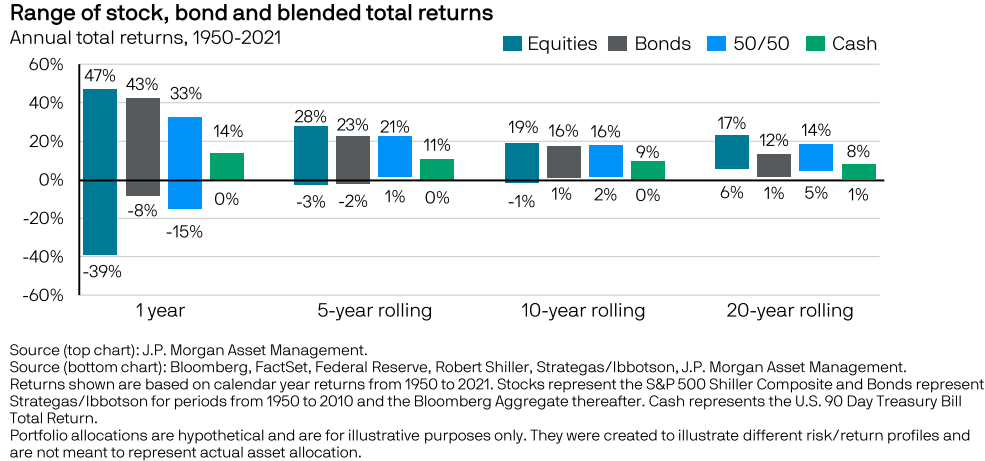
This also highlights the importance of having a long timeframe. The chart below shows how the range of investment returns shrinks over time, and becomes increasingly more positive, as time extends:

It’s cliche but true: investing for the long term is the key to success. The longer you hold any investment, the higher the likelihood of a positive return. 

The Bond Market

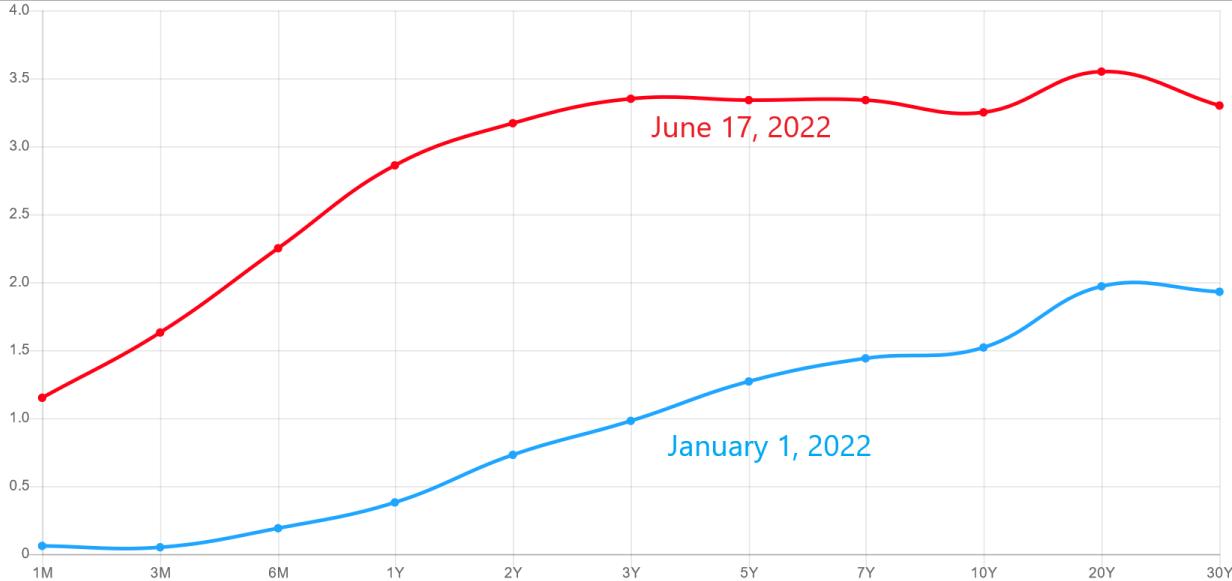
Since the start of the year interest rates have risen dramatically: 

The Federal Reserve is raising rates in order to increase the cost of borrowing. For example, mortgage rates have doubled since the start of the year. These higher borrowing costs tend to slow economic activity. Over time, the Federal Reserve hopes lower demand will bring down inflation. 

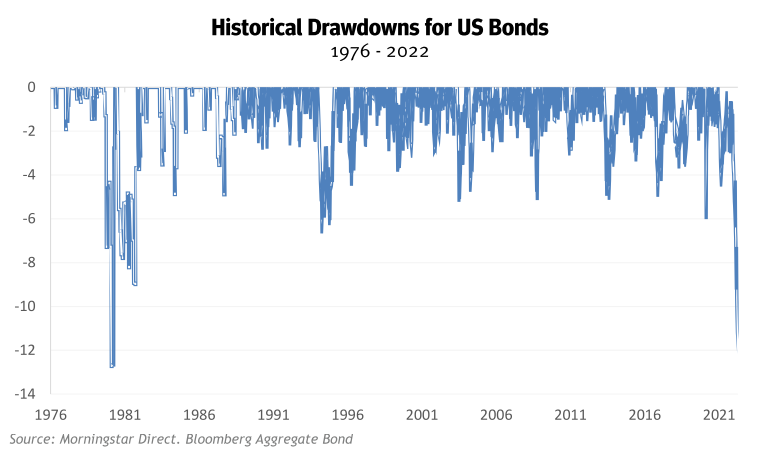
The bad news is that when interest rates rise, bond prices fall. As shown in the chart below, this has resulted in the bond market declining quite substantially: 

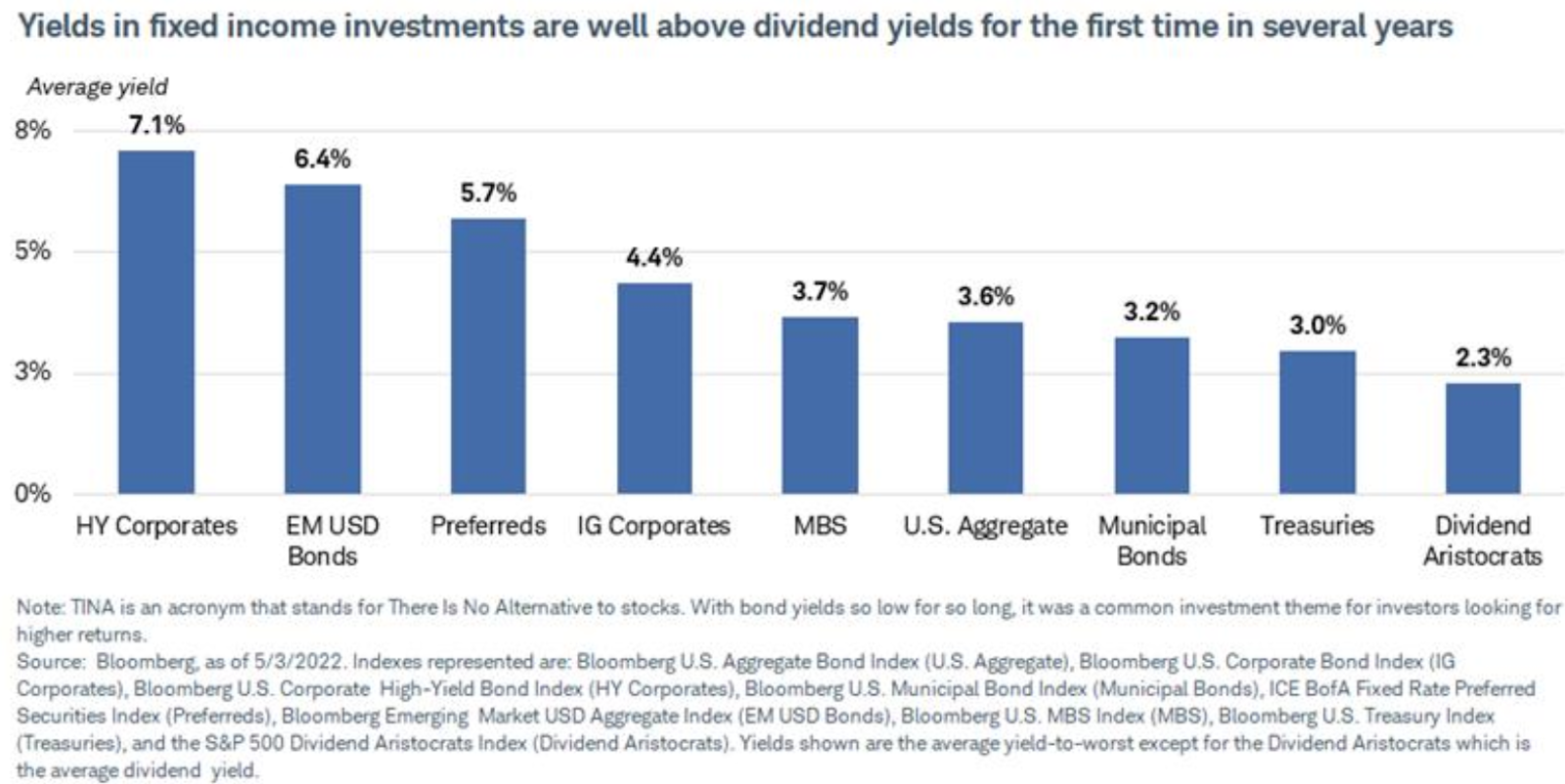
The good news is that higher interest rates increase the expected returns of bonds going forward. Here’s a look at the average yield of various bonds:

The question now is: what to do? When the bond market has losses, does it make sense to get out? 

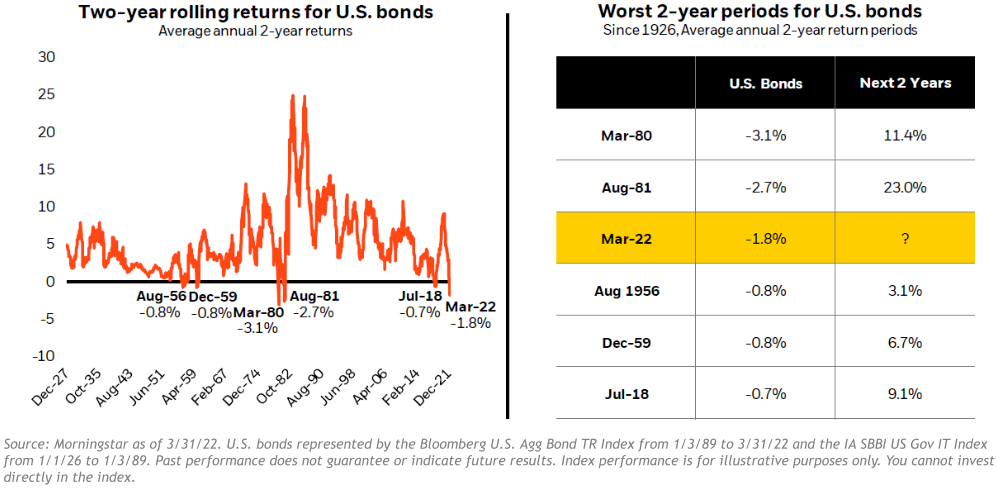
The data shows that rising interest rates and falling bond prices have little predictive value. The fact that rates are rising and bond prices falling in one period tells you nothing about how those bonds will perform in the future. 

The graphic below shows what happened in other periods where bond performance had been particularly bad. It shows that when bonds had their worst 2-year performance, the subsequent 2 years have usually produced very good returns.

If this pattern holds, we could see a similar pattern emerge in the near future. 

Recession?

There’s a lot of discussion and articles about whether or not we’re in a recession. Morgan Housel says it well: “We’re always heading toward a recession, we just have no idea when it’ll begin.” 

While it’s unclear whether or not we’re in a recession right now, what is clear is that the stock market is down. 

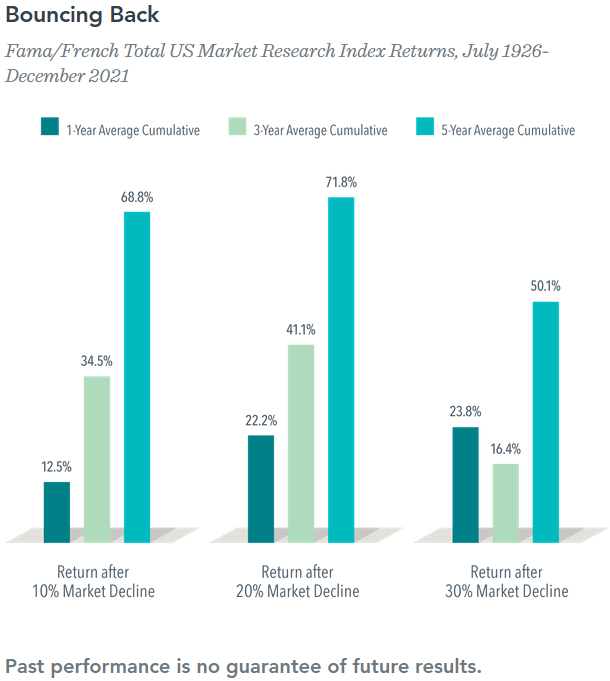
Below is a very informative chart. It shows the average 1-, 3-, and 5-year returns after the stock market declines 10%, 20%, and 30%. After a 20% decline (like we’re in now), the average 1-year return is 22%. And again, the longer the time frame the higher the return:

Market Timing

“The idea that a bell rings to signal when investors should get into or out of the market is simply not credible. After nearly 50 years in this business, I do not know of anybody who has done it successfully and consistently. I don’t even know anybody who knows anybody who has done it successfully and consistently.”

– John Bogle, Founder, Vanguard

Some investors may be tempted to cash in their chips and head to the sidelines until things look brighter. Or they may want to reduce exposure to a particular investment that isn’t doing well, then jump back in when the performance improves.

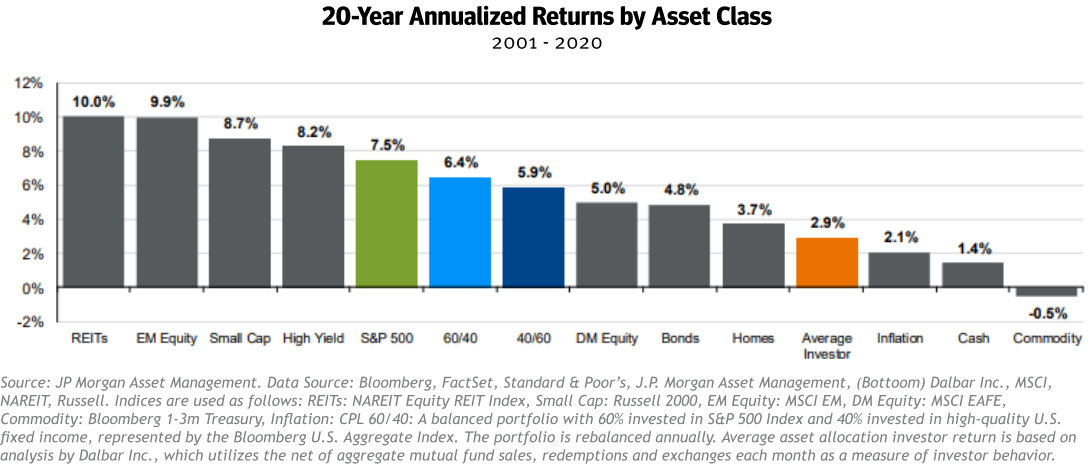
This is known as market timing, and it doesn’t always work. The graphic below shows just how damaging it can be. It shows the returns of various asset classes from 2001 through 2020. It also shows the return for the average investor (in orange):

The average investor generated 2.9% per year during a period when almost every asset class, including stocks (+7.5%) and bonds (+4.8%), were up much more. How? It’s because many investors try to time the market, and they almost always get it wrong.

You don’t have to predict the future to be a successful investor. Look at the two blue bars representing the 60% stock and 40% bond portfolio and the 40% stock 60% bond portfolio. If you had invested in one of those and simply stayed put, you would have done over twice as well as the average investor.

Summary

Successful investors have patience, discipline, and conviction in their portfolios. While it’s not comfortable or easy to sit tight during difficult periods, better times have always come. 

Subscribe

Join Our Newsletter

Sign up to receive an email when new articles are posted.

The information, analysis, and opinions expressed herein are for general and educational purposes only. Nothing contained in this commentary is intended to constitute legal, tax, accounting, securities, or investment advice, nor an opinion regarding the appropriateness of any investment, nor a solicitation of any type. The material has been gathered from sources believed to be reliable, however Think Different Financial Planning cannot guarantee the accuracy or completeness of such information, and certain information presented here may have been condensed or summarized from its original source. All opinions and views constitute our judgments as of the date of writing and are subject to change at any time without notice. Past market performance does not indicate future results.

Recent Market Volatility

Recent Market Volatility

I wanted to share a few pieces of information regarding the recent market volatility.

The Bad News

Succinctly put, it’s been a bad start to the year. The reasons are well known: inflationary worries, the Russia-Ukraine war, high oil prices, Covid shutdowns in China, and supply-chain shortages.

The S&P 500, an index of the 500 largest US stocks, is down 16%. The damage is worse in the technology sector: Nvidia (-49%), Facebook (-47%), Amazon (-41%), Microsoft (-25%), Alphabet (-24%), and Apple (-20%), are a few examples. Smaller companies that were pandemic favorites, such as Peloton (-89%), Shopify (-79%), Zoom (-78%), and PayPal (-75%), are down even more.

Usually when stocks decline, bonds cushion the blow. Unfortunately, with interest rates rising bonds are down about 12%.

The decline in stocks and bonds concurrently has led to an environment where essentially all investors are down.

The Good News

  • This is Normal: Since 1980 the S&P 500 index has had positive returns in 33 of the past 41 years. In most years, even the positive ones, there has been a significant decline at some point during the year. The average decline is about 14%, which is not too far off the 16% decline in 2022.
  • Higher Interest Rates are Encouraging: Part of the reason interest rates are rising is because the economy is doing well. Higher interest rates, relative to where they’ve been over the past few years, are normal. This will lead to more income in your bank account and higher returns for bonds.
  • Home Prices: Nationwide home prices are up 20% over the past year and 40% over the past three years.
  • Opportunity to Tax-Loss Harvest: While nobody likes losing money, the current environment is a good opportunity for tax-loss harvesting. This is exactly what we’ve done for managed accounts.
  • The Job Market is Strong: All private-sector jobs lost during Covid have been recovered. There are also twice as many job openings as there are people looking for a job.
  • Company Earnings: During Q1, earnings-per-share have grown 6.7%, much higher than the long-term average of 4.1%. While this is lower than the Q4 average of 13%, it’s not as if public companies are shrinking.
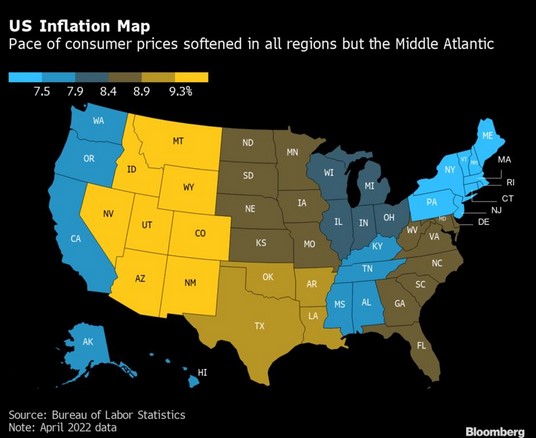
  • Inflation: While inflation is higher than it’s been over the past decade, there are signs of deceleration. The inflationary trends also depends where in the country you live (the west coast being lower than elsewhere):

If you’d like to read more, here are a couple articles and excerpts:

“Look at a chart of the S&P 500. It goes up over time. Why would you want to hop off something that has historically generated 8-10% annual returns?…You were probably expecting a pullback at some point. Well, here it is. You cannot expect a pullback and then freak out when it happens. I mean, you can, but you’re not going to have much success if you do.”

“If you buy the market [i.e., a diversified portfolio], every sell-off in history has been a buying opportunity.”

“Every time stocks fall it feels like they’re going to fall even further. It’s always much easier to look back at a long-term chart and kick yourself for not buying when stocks were falling in the past. When you know the exact bottom, investing is easy. But when you’re living through it these corrections it always feels like they’re only going to get worse.”

Subscribe

Join Our Newsletter

Sign up to receive an email when new articles are posted.

The information, analysis, and opinions expressed herein are for general and educational purposes only. Nothing contained in this commentary is intended to constitute legal, tax, accounting, securities, or investment advice, nor an opinion regarding the appropriateness of any investment, nor a solicitation of any type. The material has been gathered from sources believed to be reliable, however Think Different Financial Planning cannot guarantee the accuracy or completeness of such information, and certain information presented here may have been condensed or summarized from its original source. All opinions and views constitute our judgments as of the date of writing and are subject to change at any time without notice. Past market performance does not indicate future results.