Weekly Newsletter: The 3-1-1

Weekly Newsletter: The 3-1-1

I hope you’re having a great week.

Please see this week’s articles, chart, and quote below, along with two bonus posts written by me.

3 Articles

How Much Money Do You Need To Make To Be Considered Rich?
Ben Carlson, A Wealth of Common Sense

Nearly 40% of households in the United States earn less than $50k a year. Two-thirds of households make less than six-figures. And anything over $200k a year puts you in the top 10%.


SPACs, NFTs, and GameStop
Peter Mallouk, Creative Planning

This article summarizes some of the trendier finance topics that have been in the headlines lately.


The Agony of High Returns
Morgan Housel, The Motley Fool

This is an old article from 2016, but the counterintuitive lessons remain. It’s about how even with a time machine a lot of people wouldn’t want to own the best-performing stocks. One of the companies it focuses on is Monster Beverage, which was the best-performing stock from 1995 – 2015, earning a return of 105,000%, which would have turned a $10,000 investment into more than $10 million.

1 Chart

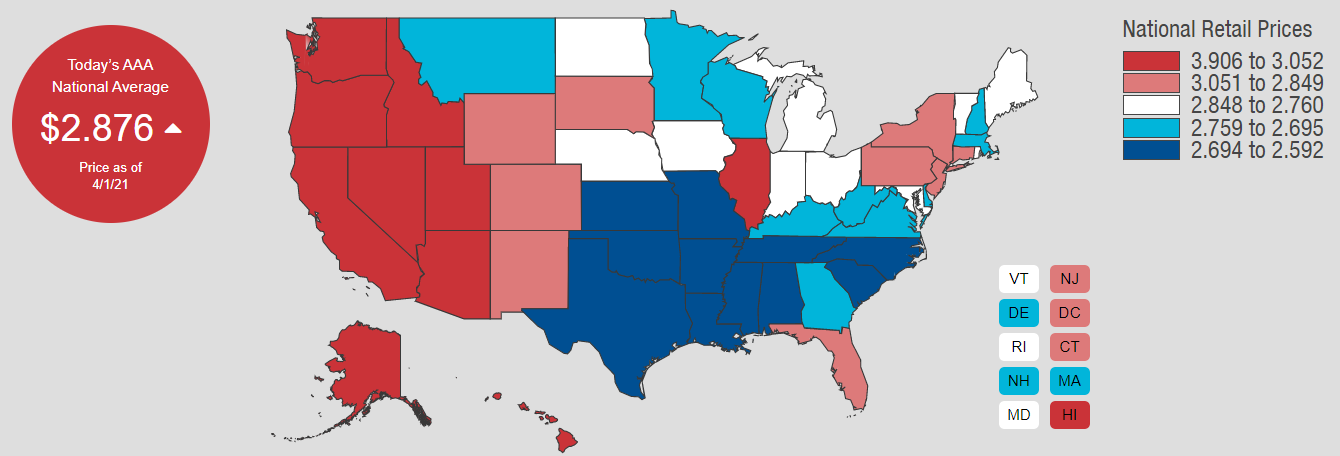
Nationwide gas prices are 84 cents more expensive as compared to a year ago.

The top 5 most expensive states are: California ($3.87), Hawaii ($3.64), Washington ($3.32), Nevada ($3.31), and Oregon ($3.17).
    1 Quote

    “Investing is much like dieting: It is simple, but not easy. Everyone knows what it takes to lose weight (eat less, exercise more). Nothing could be simpler, but few things are harder in a world full of chocolate cake and Cheetos.

    Likewise, investing is simple: Diversify, buy and hold, keep costs low. But simple isn’t easy in a market seething with “free” online trades, funds that promise to transform losses into gains, and TV pundits who shriek out trading advice as if their underpants were on fire. The real secret to being, or becoming, an intelligent investor is bolstering your self-control.”

    – Jason Zweig

      Bonus Content | Articles by Will This Week

      Saving Rates vs. Investment Returns
      This article answers the question, what matters more: a) how much you save in your investment account, or b) your investment’s rate of return?

        Subscribe

        Join Our Newsletter

        Sign up to receive an email when new articles are posted.
        Disclosure: The information being provided is strictly as a courtesy/convenience. When you link to any of the web sites provided here, you are leaving this website. We make no representation as to the completeness or accuracy of information provided at these websites.
        Think Different Financial Planning is not liable for any direct or indirect technical or system issues or any consequences arising out of your access to or your use of third-party technology, web sites, information and programs made available through this website.
        When you access one of these web sites, you are leaving this web site and assume total responsibility and risk for use of the web sites you are visiting.
        Think Different Financial Planning does not make any representations or warranties as to the accuracy, timeliness, suitability, completeness, or relevance of any information prepared by any unaffiliated third party, whether linked to Think Different Financial Planning’s web site or incorporated herein, and takes no responsibility thereof.
        Savings Rates vs. Investment Returns

        Savings Rates vs. Investment Returns

        When it comes to investing, most people focus on their rate of return.

        However, an often overlooked part of the investment process is the “savings rate.” This is simply how much you’re contributing to your investment accounts.

        Earning a positive rate of return is important, but it might surprise you to learn how important the savings rate is.

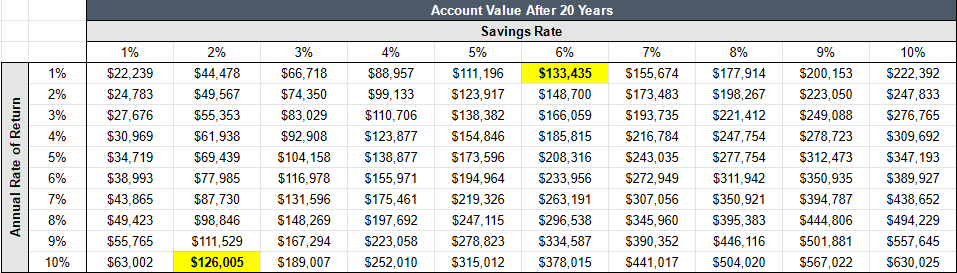
        The chart below shows the value of an investment account after twenty years for someone earning $100,000 per year. The savings rate and rate of return are the variables:

        As you can see in the highlighted cells, someone saving 2% of their income earning 10% per year ends up with a smaller balance than someone saving 6% of their income earning just 1% per year.

        In other words, the amount you contribute is far more important than your investment returns.

        We all want positive returns, but your savings rate is a major factor that can help lead to financial success.

        Subscribe

        Join Our Newsletter

        Sign up to receive an email when new articles are posted.
        The information, analysis, and opinions expressed herein are for general and educational purposes only. Nothing contained in this commentary is intended to constitute legal, tax, accounting, securities, or investment advice, nor an opinion regarding the appropriateness of any investment, nor a solicitation of any type. The material has been gathered from sources believed to be reliable, however Think Different Financial Planning cannot guarantee the accuracy or completeness of such information, and certain information presented here may have been condensed or summarized from its original source. All opinions and views constitute our judgments as of the date of writing and are subject to change at any time without notice.
        Weekly Newsletter: The 3-1-1

        Weekly Newsletter: The 3-1-1

        I hope you’re having a great week.

        Please see this week’s articles, chart, and quote below, along with two bonus posts written by me.

        3 Articles

        One Year Later and We’ve Already Forgotten
        Jason Zweig, The Wall Street Journal

        In the past year the Dow Jones Industrial Average and the S&P 500 each gained 76%, the best 12-month performance for either index since February 1934.

        Those explosive gains have blown away any financial memories of pain and loss and fear. When we try to reconstruct how we felt a year ago, the subsequent gains in our portfolios color the original bleeding red a soothing green.

        Getting Rich versus Staying Rich
        Blair Belle, The Belle Curve

        Getting rich and staying rich are two very different skills. Getting rich is exciting, even thrilling, and often includes lots of risk taking. Staying rich is boring, bordering on mundane

        Bay Area Home Sales Surge as Buyers Sense End of COVID
        Louis Hansen, San Jose Mercury News

        Realtors say the Bay Area market has become even more competitive, with shoppers looking for more space, bigger lots and move-in ready features in the suburbs. A strong stock market, lifting the incomes of tech professionals and other investors, and historically low interest rates of around 3 percent have increased the purchasing power of buyers

        1 Chart

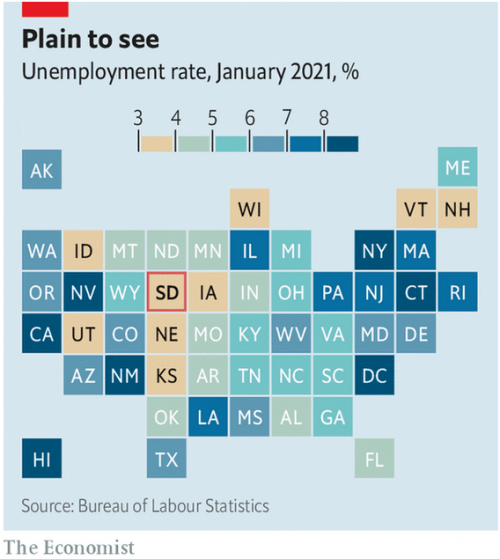
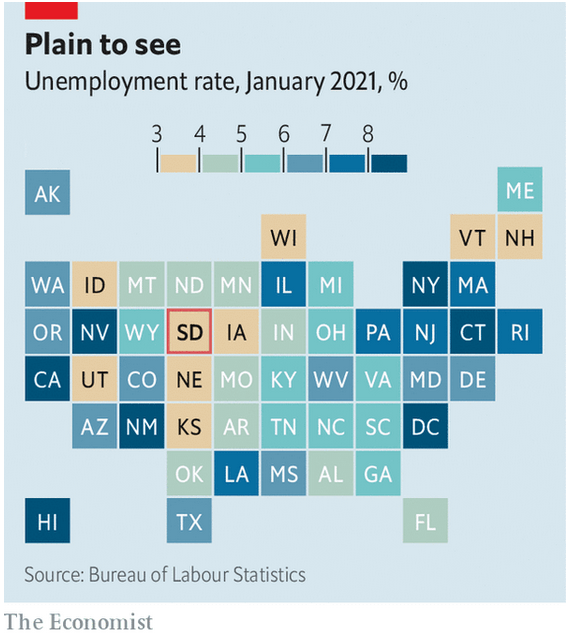
        Unemployment rate by state.

        South Dakota’s is the lowest in the country at 3.1%.

          1 Quote

          “It’s easy to look at winning stocks and feel regret for missing them. It’s hard to look at a stock and realize you would never have been able to hold on through all the ups and the downs. The financial road always appears more clear when you’re looking in the rearview mirror.”

          –
          Michael Batnick

            Bonus Content | Articles by Will This Week

            How Does A Stock Earn You Money
            On the difference between dividends and the increase in share prices.

            Time In The Market
            On the importance of having a long time horizon for your investments.

              Subscribe

              Join Our Newsletter

              Sign up to receive an email when new articles are posted.
              Disclosure: The information being provided is strictly as a courtesy/convenience. When you link to any of the web sites provided here, you are leaving this website. We make no representation as to the completeness or accuracy of information provided at these websites.
              Think Different Financial Planning is not liable for any direct or indirect technical or system issues or any consequences arising out of your access to or your use of third-party technology, web sites, information and programs made available through this website.
              When you access one of these web sites, you are leaving this web site and assume total responsibility and risk for use of the web sites you are visiting.
              Think Different Financial Planning does not make any representations or warranties as to the accuracy, timeliness, suitability, completeness, or relevance of any information prepared by any unaffiliated third party, whether linked to Think Different Financial Planning’s web site or incorporated herein, and takes no responsibility thereof.
              Time In The Market

              Time In The Market

              “Virtually all investing mistakes are rooted in people looking at long-term market returns and saying, ‘That’s nice, but can I have it all faster?’”

              – Morgan Housel

              One of the most important aspects to investing is time. If you are investing with a short time horizon, the odds of having a positive return decrease. Below is one of my favorite charts demonstrating that point:

              On any given day in the stock market your odds of a positive return are 53%, little better than a coin flip. If you increase that holding period to a year your odds increase to 75%. With a 5-year holding period you have an 88% chance of a positive return, and with a 20-year holding period there has been a negative return for U.S. stocks.

              If you’re investing in the stock market, the longer your time horizon the better.

              Subscribe

              Join Our Newsletter

              Sign up to receive an email when new articles are posted.
              Source: Compound Advisors
              The information, analysis, and opinions expressed herein are for general and educational purposes only. Nothing contained in this commentary is intended to constitute legal, tax, accounting, securities, or investment advice, nor an opinion regarding the appropriateness of any investment, nor a solicitation of any type. The material has been gathered from sources believed to be reliable, however Think Different Financial Planning cannot guarantee the accuracy or completeness of such information, and certain information presented here may have been condensed or summarized from its original source. All opinions and views constitute our judgments as of the date of writing and are subject to change at any time without notice.
              How Does A Stock Earn You Money?

              How Does A Stock Earn You Money?

              There are two ways a stock can earn you money.

              1. Capital Appreciation: This is the increase in share price. For example, when you hear about a stock being “up” a certain amount, that’s capital appreciation

              2. Dividends: Many companies will pay their shareholders a percent of their profits as a dividend. For example, if you own $1,000 of a stock that pays a 2% dividend, you would receive $20 per year simply for being a shareholder. Think of it as the company saying “thank you” for being an investor.

              But which one of these is more important?

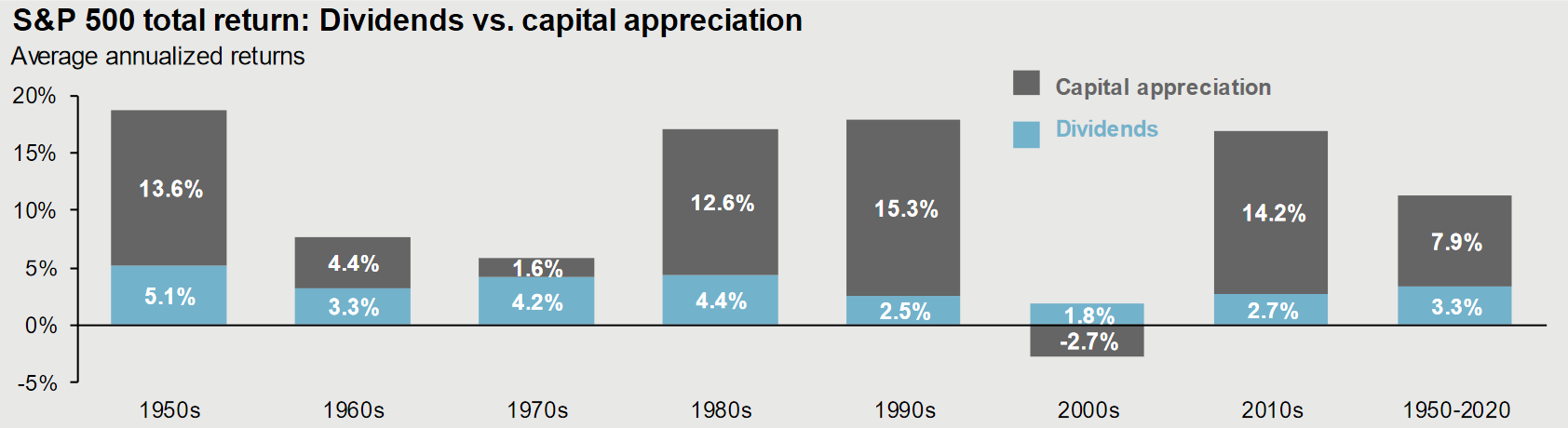
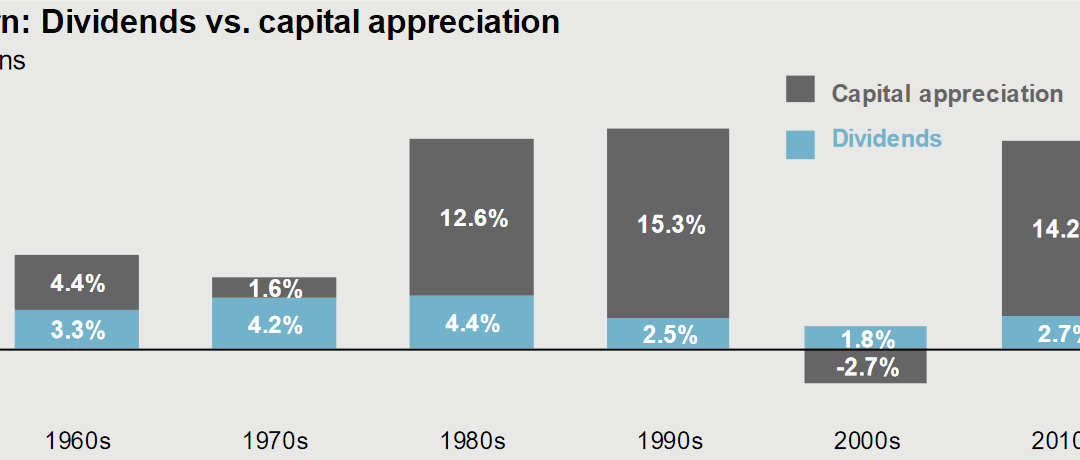
              The chart below shows the S&P 500’s return per decade, breaking out the amount produced by capital appreciation and dividends:

              Dividends were a positive contributor every decade. They accumulate over time and can be reinvested to earn more. Capital appreciation, on the other hand, was much more volatile. While there were some great decades for capital appreciation (e.g., 2010s, 1990s, 1980s, and 1950s) there were also decade-long droughts (e.g., 2000s, 1970s).

              From 1950-2020, the “total return” (capital appreciation + dividends) from the S&P 500 was 11.2%. Dividends provided 3.3% of that return (~30%) and capital appreciation provided 7.9% (~70%). 

              Capital appreciation has driven the majority of the return, but dividends were helpful too, especially in the decades where capital appreciation was low or negative.

              Subscribe

              Join Our Newsletter

              Sign up to receive an email when new articles are posted.

              The information, analysis, and opinions expressed herein are for general and educational purposes only. Nothing contained in this commentary is intended to constitute legal, tax, accounting, securities, or investment advice, nor an opinion regarding the appropriateness of any investment, nor a solicitation of any type. The material has been gathered from sources believed to be reliable, however Think Different Financial Planning cannot guarantee the accuracy or completeness of such information, and certain information presented here may have been condensed or summarized from its original source. All opinions and views constitute our judgments as of the date of writing and are subject to change at any time without notice.
              Weekly Newsletter: The 3-1-1

              Weekly Newsletter: The 3-1-1

              Happy Friday!

              This week we’re back to our regularly scheduled content: 3 articles, 1 chart, and 1 quote related to personal finance.

              3 Articles

              Why America’s Housing Market Has Never Been Weirder
              Derek Thompson, The Atlantic

              In America’s largest, richest cities, home prices and rents are going in opposite directions.

              Invest Like a Pronghorn
              Anonymous, Breaking The Market

              This is an interesting investing allegory about cheetahs and pronghorns. They’re both extremely fast runners, and the story nicely describes how their different capabilities translate to the investing world.

              Sign of Inequality: US Salaries Recover Even As Jobs Haven’t
              Christopher Rugaber, AP News

              The vanished earnings from 8.9 million Americans who have lost jobs to the pandemic remain less than the combined salaries of new hires and the pay raises that the 150 million Americans who have kept their jobs have received.

              1 Chart

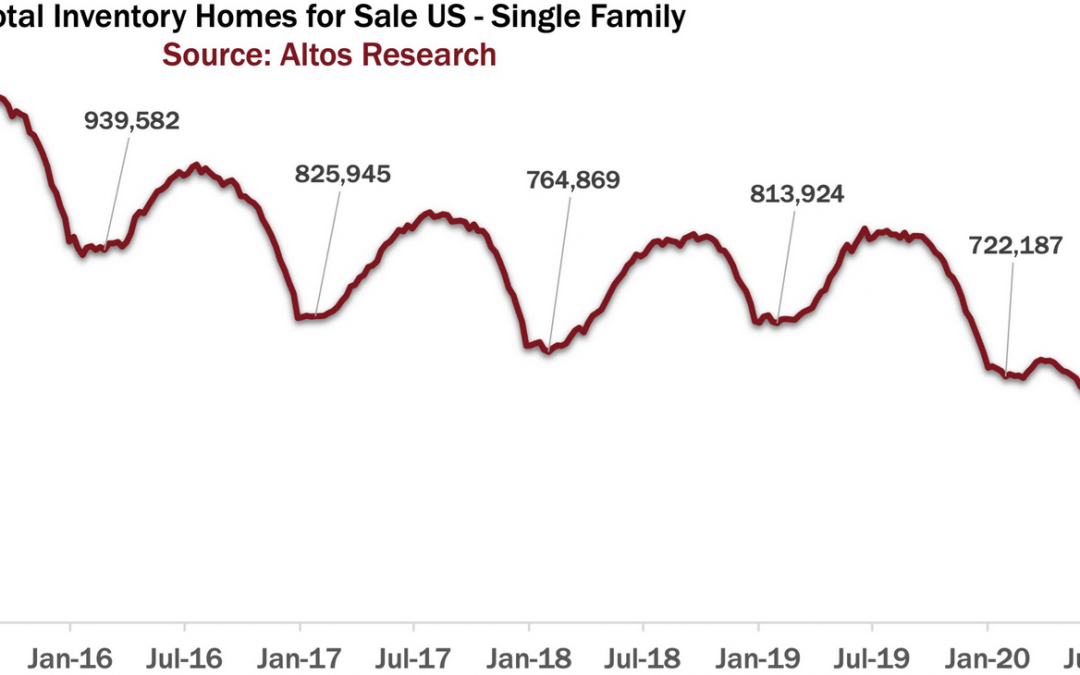
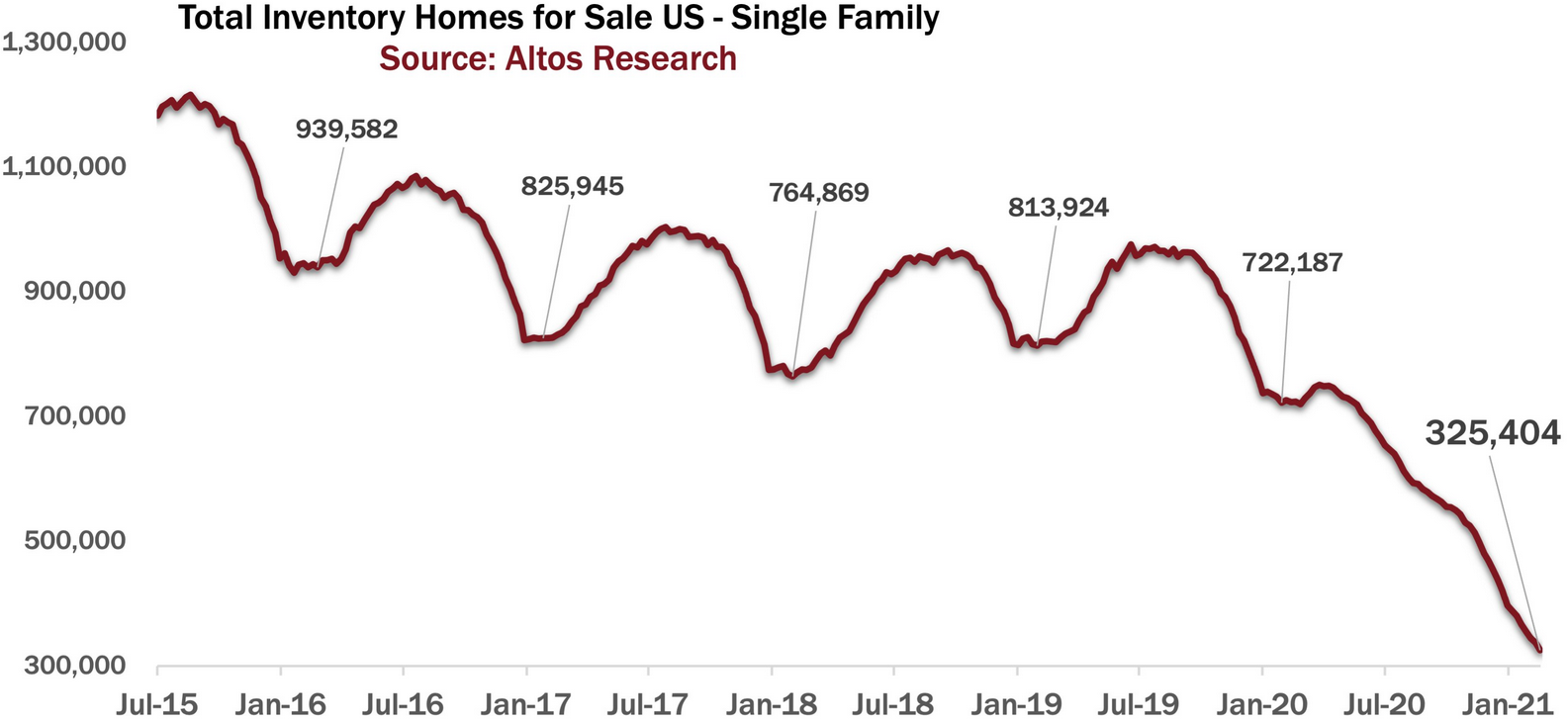
              This is a crazy stat: across the US, there are approximately one-third as many homes for sale versus 2016. Inventory is very low!

                1 Quote

                “It’s not whether you’re right or wrong that’s important, but how much money you make when you’re right and how much you lose when you’re wrong.”

                – George Soros

                  Subscribe

                  Join Our Newsletter

                  Sign up to receive an email when new articles are posted.
                  Disclosure: The information being provided is strictly as a courtesy/convenience. When you link to any of the web sites provided here, you are leaving this website. We make no representation as to the completeness or accuracy of information provided at these websites.
                  Think Different Financial Planning is not liable for any direct or indirect technical or system issues or any consequences arising out of your access to or your use of third-party technology, web sites, information and programs made available through this website.
                  When you access one of these web sites, you are leaving this web site and assume total responsibility and risk for use of the web sites you are visiting.
                  Think Different Financial Planning does not make any representations or warranties as to the accuracy, timeliness, suitability, completeness, or relevance of any information prepared by any unaffiliated third party, whether linked to Think Different Financial Planning’s web site or incorporated herein, and takes no responsibility thereof.