Investment Commentary – First Quarter, 2021

Investment Commentary – First Quarter, 2021

Highlights

Further economic stimulus, continued vaccination progress, and overall positive sentiment contributed to a positive start to the year for stocks. Passage of the $1.9 trillion stimulus package and potential for significant infrastructure spending in the United States were certainly viewed in a positive light by investors. Vaccine deployment across the world ramped up quickly through the quarter, rising to an average of over 3 million doses being administered in the US per day and over 15 million doses per day globally.

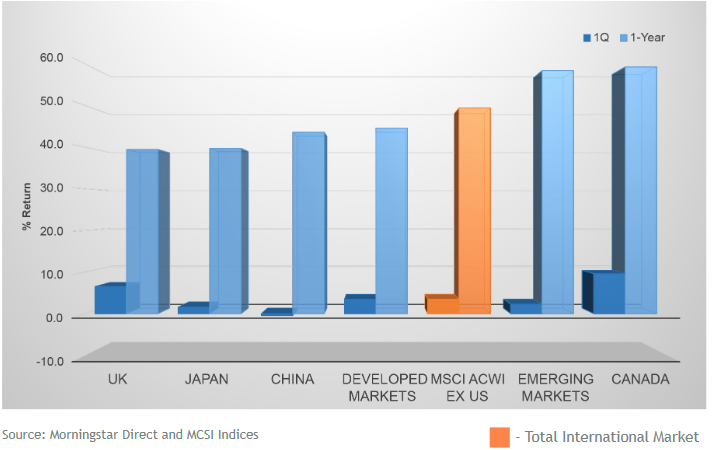
In the equity markets the US generated the strongest gains with small capitalization stocks leading. International developed and emerging markets also posted positive gains, while modestly trailing US markets. As we look back over the past 12 months, the gains experienced are significant with many markets up over 50% and small cap value in the US up over 100% from the lows seen last March. While informative to see how strongly the markets have rebounded, it is important to keep perspective and remember these are measured from the lows and even just extending the time period to 13 months would meaningfully change the numbers.

Within fixed income, short-term interest rates remain near zero, with continued accommodative positions by the Federal Reserve and other global central banks. While the Federal Reserve indicates they remain committed to keeping short-term rates low, the overall direction of the markets and the economy has led to interest rates on intermediate and longer-term bonds moving up during the quarter, weighing on results for fixed income.

US Stocks

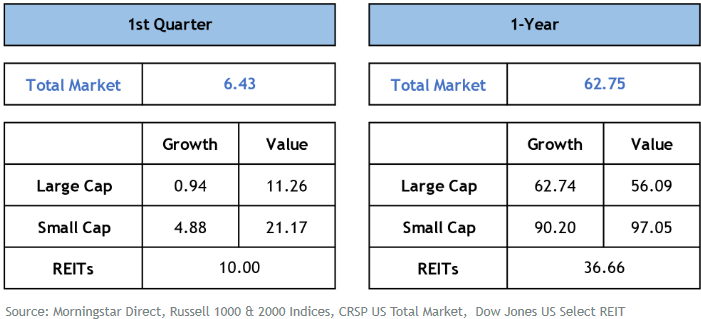
Stocks in the US gained 6.43% during the quarter and are up 62.75% over the last year. Over the past several years, there has been a wide divergence among equity styles, led by larger growth-oriented stocks. In the fourth quarter of last year, value and smaller-cap names began leading and continued their outperformance through the first quarter. After underperforming the broad market in 2020, REITs rebounded in the first quarter.

International Stocks

International stocks also gained during the quarter, appreciating 3.5% and 2.5% for developed and emerging markets, respectively. Again, one-year returns have meaningfully exceeded virtually everyone’s expectations as investors look forward to the opportunities beyond the current situation. 
Bonds

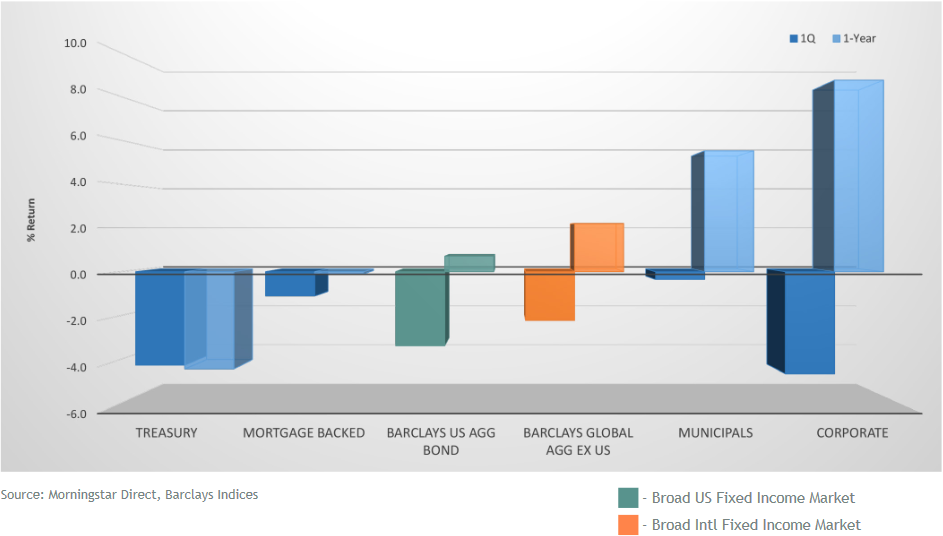
Returns within fixed income were generally down during the quarter as interest rates rose. Perhaps unsurprisingly, after performing very well during the flight to quality last March, Treasuries have been the weakest area over the last year. Hedged international bonds have provided diversification and benefit where held in portfolios as global yield curves have not moved in tandem with the US. Municipal bonds performed well on a relative basis and held up better than most taxable sectors during the quarter.
Parting Thoughts

The S&P 500 Index is one of the most commonly cited and referenced indexes in the world. It appears on the front page of major news sites, in countless articles, and is a barometer than many use to gauge how the markets are doing. Yet, it is actually a fairly narrow definition of the markets. It represents the (approximately) 500 largest US stocks. Yet the global investable market is comprised of over 10,000 stocks. It includes small, mid, and large cap. It includes both the US and over 40 other developed and emerging markets countries. The global opportunity set also contains thousands of fixed income securities.

While most investors understand that their portfolios are structured and managed to their unique goals and objectives, and often bears little resemblance to the composition of the S&P 500, the sheer visibility of the S&P 500 makes it a common point of comparison, even if unintentional. The following chart helps illustrate the limitations that can come from using this as a point of comparison for an investor who holds a diversified portfolio.
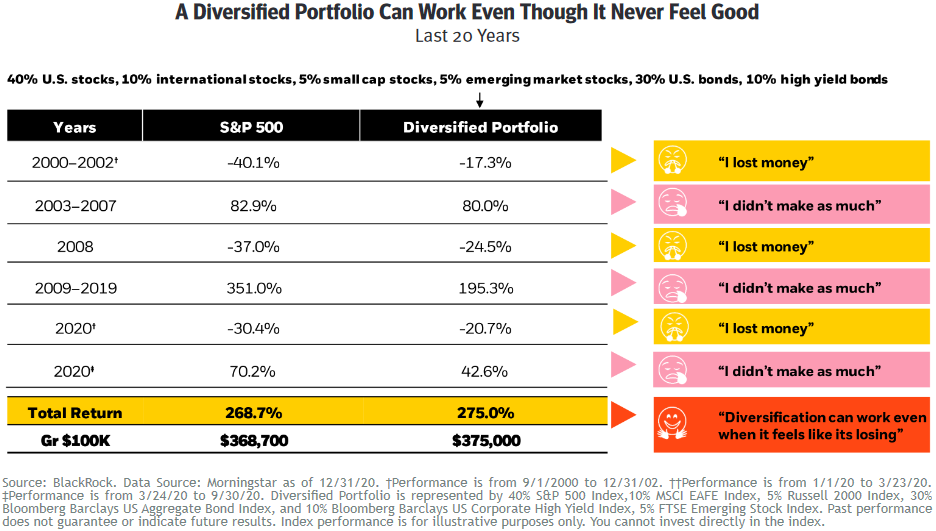
Over the last 20 years, there have been multiple up and down cycles. In down markets, an investor may feel like things are not going well because they are down (even if they haven’t lost as much as the S&P). Research has shown that investors tend to be more sensitive to the pain of losses in portfolios. Then in up markets, they may feel like they are losing out because their portfolio has not gained as much as the S&P. However, as BlackRock points out, even though it may never feel good being in a diversified portfolio, the end result over 20 years was similar but with meaningfully less volatility and risk taken.

Subscribe

Join Our Newsletter

Sign up to receive an email when new articles are posted.

Disclaimer: The opinions expressed in this article are for general informational purposes only and are not intended to provide specific advice or recommendations for any individual or on any specific security. The material is presented solely for information purposes and has been gathered from sources believed to be reliable, however Think Different Financial Planning cannot guarantee the accuracy or completeness of such information, and certain information presented here may have been condensed or summarized from its original source. Think Different Financial Planning does not provide tax or legal advice, and nothing contained in these materials should be taken as such. As always please remember investing involves risk and possible loss of principal capital. Advisory services are only offered to clients or prospective clients where Think Different Financial Planning and its representatives are properly licensed or exempt from licensure. No advice may be rendered by Think Different Financial Planning unless a client service agreement is in place.
Weekly Newsletter: The 3-1-1

Weekly Newsletter: The 3-1-1

Please see this week’s articles, chart, and quote below, along with a bonus posts by me and my first media mention!

3 Articles

Bernie Madoff’s Downfall Left Behind A Surprising Legacy
Helaine Olen, The Washington Post

Bernie Madoff, who ran the largest Ponzi scheme in history and lost $20 billion, passed away this week.

 How to Plan and Pay for Healthcare Costs in Retirement
Robert Powell, Marketwatch

 Ten Facts to Know About Financing College
Tony Isola, A Teachable Moment

1 Chart

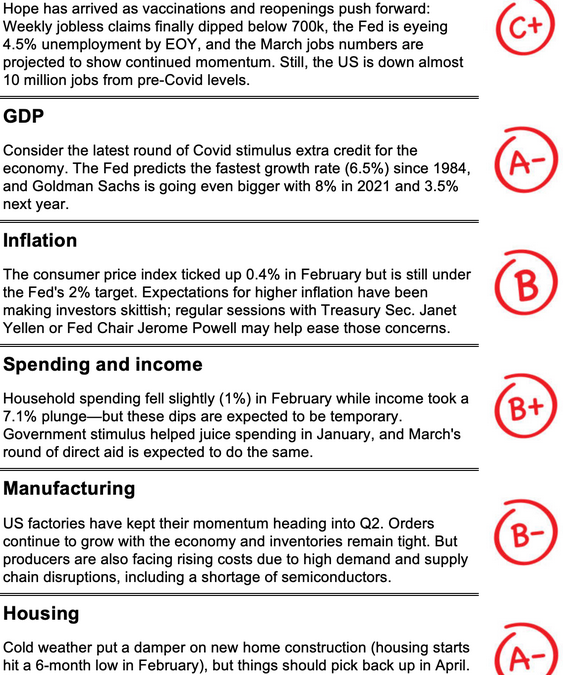
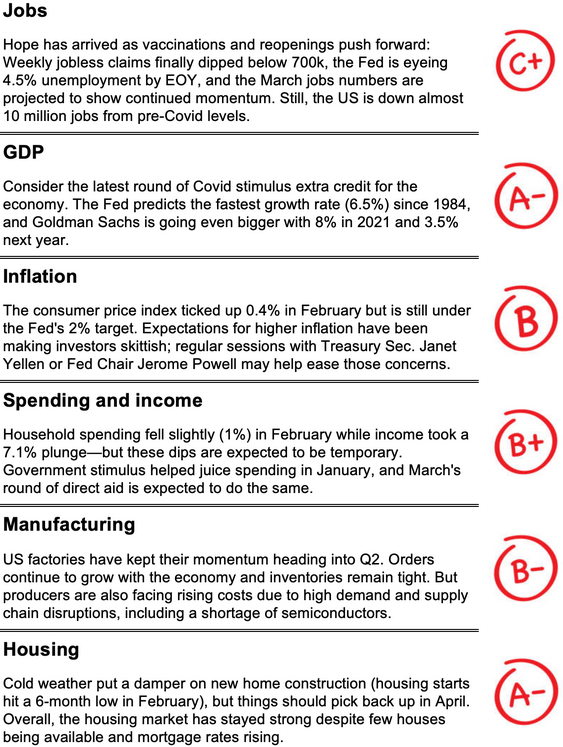
Morning Brew cleverly summarized 2021’s first quarter economic activity in report-card format.

    1 Quote

    “Whenever you are stuck searching for the optimal plan, remember: getting started changes everything.”

    – James Clear

      Bonus Content | Articles by Will This Week

      The Power of After-Tax 401(k) Contributions & Roth In-Plan Conversions
      This week I wrote about a relatively unknown feature that allows employees at publicly-traded technology companies to save a lot more than the traditional limits in their 401(k).

      Media Mention

      Retirement Guide for Late Starters
      Kim Borwick, Annuity.org

      I was honored to be featured in this article about the benefit of working with a financial advisor.

        Subscribe

        Join Our Newsletter

        Sign up to receive an email when new articles are posted.

        Disclosure: The information being provided is strictly as a courtesy/convenience. When you link to any of the web sites provided here, you are leaving this website. We make no representation as to the completeness or accuracy of information provided at these websites.
        Think Different Financial Planning is not liable for any direct or indirect technical or system issues or any consequences arising out of your access to or your use of third-party technology, web sites, information and programs made available through this website.
        When you access one of these web sites, you are leaving this web site and assume total responsibility and risk for use of the web sites you are visiting.
        Think Different Financial Planning does not make any representations or warranties as to the accuracy, timeliness, suitability, completeness, or relevance of any information prepared by any unaffiliated third party, whether linked to Think Different Financial Planning’s web site or incorporated herein, and takes no responsibility thereof.
        The Power of After-Tax 401(k) Contributions & Roth In-Plan Conversions

        The Power of After-Tax 401(k) Contributions & Roth In-Plan Conversions

        The Problem
        High earners pay a lot in taxes. To minimize those, many people contribute to a pre-tax 401(k). This reduces your taxable income and lowers your tax bill.

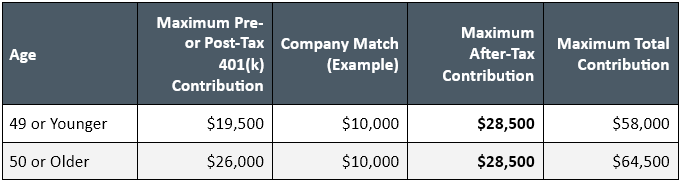
        The problem with 401(k)’s is that the maximum single-year contribution is limited to $19,500, or $26,000 if you are over age 50.

        What can high earners do to save more in a tax-aware way?

        The Solution
        Two 401(k) features that are available at some publicly-traded technology companies (e.g., Apple, Alphabet, Facebook, Microsoft, and others) provides a fix: 1) after-tax contributions and 2) Roth in-plan conversions.

        These features allow you to save much more than the regular 401(k) limits. This lesser-known strategy, also known as the “Mega Backdoor Roth,” is used by savvy investors to save significant amounts of money.

        How Does It Work?
        Throughout the year you can contribute to the after-tax portion of your 401(k) via paycheck deductions. Like Roth contributions, after‑tax contributions are made with after‑tax dollars. The contributions are not tax deductible. You will not owe taxes on a withdrawal of your after-tax contributions, however, you will owe income taxes on any investment gains those contributions produce.

        To avoid this future taxation, you can utilize the “Roth in-plan conversion.” This converts your after-tax contributions to your Roth 401(k). This means that both your contributions and investment gains can be withdrawn tax-free in retirement (assuming you are at least age 59 ½ and you made your first Roth contribution five years earlier.)

        Some companies even allow automatic in-plan conversions, which makes this process even easier. All you need to do is decide how much to contribute.

        How Much Extra Can I Contribute?
        This will depend on your company’s 401(k) match. In the example below, we’ve assumed the company matches $10,000 per year. In that scenario you would be able to contribute an extra $28,500 per year.

        Summary
        If you max out your traditional or Roth 401(k), do not need the additional cash, and are looking to save more for retirement in a Roth account, consider after-tax contributions and Roth in-plan conversions. It’s an effective way for high earners to save significant amounts of money tax-free beyond the traditional routes.

        If you have questions about your after-tax 401(k), please let us know. We are happy to help.

        Subscribe

        Join Our Newsletter

        Sign up to receive an email when new articles are posted.

        The information, analysis, and opinions expressed herein are for general and educational purposes only. Nothing contained in this commentary is intended to constitute legal, tax, accounting, securities, or investment advice, nor an opinion regarding the appropriateness of any investment, nor a solicitation of any type. The material has been gathered from sources believed to be reliable, however Think Different Financial Planning cannot guarantee the accuracy or completeness of such information, and certain information presented here may have been condensed or summarized from its original source. All opinions and views constitute our judgments as of the date of writing and are subject to change at any time without notice.
        Weekly Newsletter: The 3-1-1

        Weekly Newsletter: The 3-1-1

        This week The 3-1-1 is all about real estate.

        In one of the more surprising twists of the Covid-19 pandemic, the residential real estate market has done exceedingly well. This weeks articles, chart, and quote provide further insight and information.

        3 Articles

        Bay Area Home Prices Soar on Suburban Land Rush
        Louis Hansen, San Jose Mercury News

        Tight inventory and high demand for traditional suburban neighborhoods drove up median prices for an existing home in Contra Costa County 25% to $737,000, and up nearly 13% to $1.6 million in San Mateo.

        The Housing Market Is Crazier Than It’s Been Since 2006
        Nicole Friedman, The Wall Street Journal

        The past year has been the hottest for sales activity in 14 years. Home values are rising in practically every corner of the U.S., and median sale prices in dozens of metro areas have posted double-digit percentage increases from a year ago.

        But…What If Housing Prices Aren’t As High As They Appear?
        Ben Carlson, A Wealth of Common Sense

        This article looks at the median home price across this country, and shows how, after adjusting for inflation and interest rates, monthly mortgage payments are now 30% lower than they were in 1989.

        1 Chart

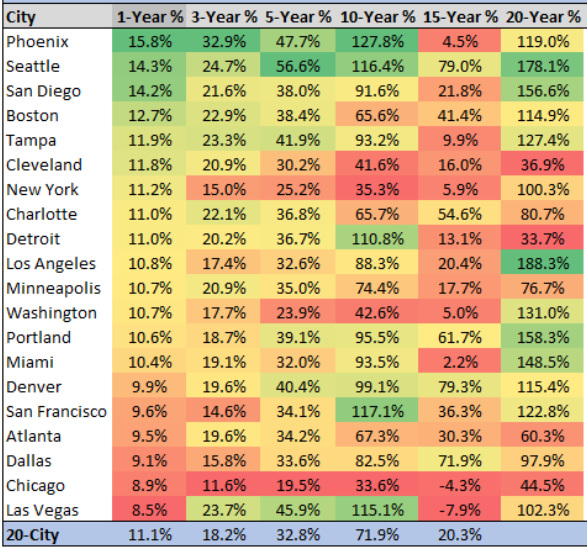
        Nationwide home prices were up 11% over the past 1 year.

        See how specific ares have done in the table below:

          1 Quote

          “[Housing] Prices are up virtually everywhere…It is surprising to see home prices rebound this quickly, by this magnitude, this early into an economic recovery.”

          – Mark Vitner, senior economist at Wells Fargo & Co. 

            Bonus Content | Articles by Will This Week

            What Are Restricted Stock Units (RSUs)?
            RSUs are a form of compensation provided by publicly-traded companies. If you are a recipient, I recommend you take a read!

            19 Questions To Ask Your Financial Advisor
            I provide my response to 19 questions to ask your financial advisor.

              Subscribe

              Join Our Newsletter

              Sign up to receive an email when new articles are posted.

              Disclosure: The information being provided is strictly as a courtesy/convenience. When you link to any of the web sites provided here, you are leaving this website. We make no representation as to the completeness or accuracy of information provided at these websites.
              Think Different Financial Planning is not liable for any direct or indirect technical or system issues or any consequences arising out of your access to or your use of third-party technology, web sites, information and programs made available through this website.
              When you access one of these web sites, you are leaving this web site and assume total responsibility and risk for use of the web sites you are visiting.
              Think Different Financial Planning does not make any representations or warranties as to the accuracy, timeliness, suitability, completeness, or relevance of any information prepared by any unaffiliated third party, whether linked to Think Different Financial Planning’s web site or incorporated herein, and takes no responsibility thereof.
              19 Questions For Your Financial Advisor

              19 Questions For Your Financial Advisor

              Jason Zweig, an author and columnist at The Wall Street Journal, wrote “The 19 Questions To Ask Your Financial Advisor.”

              I liked the idea and wanted to provide my responses. I’ve also included Jason’s recommended answer in parentheses.

              1. Are you always a fiduciary, and will you state that in writing? (answer you want: yes)

              Yes. This is the most important question to ask your advisor. If they are not a fiduciary it means they are not legally required to do what is in your best interest.

              Every advisor has a choice of how they choose to practice, and that decision says a lot about their professional values. It’s a big deal and something we take seriously.

              2. Does anybody else ever pay you to advise me and, if so, do you earn more to recommend certain products or services? (answer you want: no)

              No. All the money I earn is directly from fees paid to me by my clients. I receive no revenue from insurance companies, fund providers, custodians (like Charles Schwab), or anyone else.

              3. Do you participate in any sales contests or award programs creating incentives to favor particular vendors? (answer you want: no)

              No.

              4. Will you itemize all your fees and expenses in writing? (answer you want: yes)

              Yes. See fees here.

              5. Are your fees negotiable? (answer you want: yes)

              Yes. I reserve the right to discount my fees in certain circumstances, such as working with a low-income family.

              6. Will you consider charging by the hour instead of an annual (or quarterly) fee? (answer you want: yes)

              No. At this time we’re not accepting hourly clients. 

              7. Can you tell me about your conflicts of interest? (answer you want: yes, and no adviser should deny having any conflicts.)

              Yes. I’ve tried to build a firm with as few conflicts as possible, but there is one: I have a financial motivation to take on additional clients. And the more clients I have, the less time I have to spend with each client.

              To counteract this, I will limit my client list to 70 households. That way I can continue to provide high-quality, personalized financial planning advice.

              8. Do you earn fees as adviser to a private fund or other investments that you may recommend to clients? (answer you want: no)

              No. My only source of revenue comes directly from my clients.

              9. Do you pay referral fees to generate new clients? (answer you want: no)

              No. I pay no referral fees.

              10. Do you focus solely on investment management, or do you also advise on taxes, estates and retirement, budgeting and debt management, and insurance? (answer you want: here the best answer depends on your needs as a client.)

              We provide financial planning and investment management.

              We start by focusing on the financial planning topics that are most important and relevant to you. This includes: real estate decisions, stock option analysis, cash flow planning, retirement income planning (e.g., what is a “safe” spending rate in retirement), college planning, Roth conversions, and more.

              In addition to our financial planning work, we manage your investments and review them regularly (see more on this in question #12).

              Learn more about our Services.

              11. Do you earn fees for referring clients to specialists like estate attorneys or insurance agents? (answer you want: no)

              No.

              12. What is your investment philosophy?

              We invest in a diversified, low-cost, tax-efficient manner using passive exchange-traded funds.

              We don’t believe that you can beat the market, but think you are entitled to get market rates of return.

              We emphasize keeping your investment fees as low as possible. For example, the expense ratios for our portfolios costs .04% to .06% annually ($40 to $60 per year for every $100,000 invested).

              In addition, we harvest tax losses when applicable and rebalance when appropriate. Learn more about our Investment Philosophy.

              13. Do you believe in technical analysis or market timing? (answer you want: no)

              No. I don’t believe anyone can successfully time the market or utilize technical analysis to consistently beat the market.

              14. Do you believe you can beat the market? (answer you want: no)

              No. The evidence shows that approximately 80%+ of active investment managers who try to beat the market do not. That underperformance ends up costing clients a lot of money. Rather than trying to beat the market, you should just own the market. By doing that you will outperform the majority of other investors.

              15. How often do you trade? (answer you want: as seldom as possible, ideally once or twice a year at most)

              We place trades very infrequently. If there is new cash to invest, that requires trading. Or if you need to make a withdrawal from the portfolio, that requires trading.

              Rebalancing happens once a year, or if your portfolio becomes misaligned as a result of big moves in the market.

              16. How do you report investment performance? (answer you want: after all expenses, compared to an average of highly similar assets that includes dividends or interest income, over the short and long term.)

              Clients receive quarterly performance reports. These detail your asset allocation, your short- and long-term performance, your investment positions, and a comparison to benchmarks. Clients also have daily, on-demand access to performance details through Schwab.

              17. Which professional credentials do you have, and what are their requirements? (answer you want: among the best are CFA [Chartered Financial Analyst], CPA [Certified Public Accountant] and CFP [Certified Financial Planner], which all require rigorous study, continuing education and adherence to high ethical standards. Many other financial certifications are marketing tools masquerading as fancy diplomas on an adviser’s wall.)

              I’m a Certified Financial Planner. It is the standard for financial planning.

              18. After inflation, taxes, and fees, what is a reasonable estimated return on my portfolio over the long term? (answer you want: if told anything over 3% to 4% annually, I’d be either naive or deceptive.)

              This is a tough question. Nobody can predict future returns, but we have to make assumptions in our financial planning software. Below are our return expectations prior to inflation, fees, and taxes for various risk levels:

              19. Who manages your money? (answer you want: I do, and I invest in the same assets I recommend to clients.)

              I do, and I invest in the same assets I recommend to clients. It’s a boring but extremely effective investment approach.

              What Are Restricted Stock Units (RSUs)?

              What Are Restricted Stock Units (RSUs)?

              What are Restricted Stock Units (RSUs)?

              RSUs are a form of compensation provided by publicly-traded companies to reward their employees. An easy way to think about RSUs is as a bonus, but instead of being paid in cash you’re paid in company stock.

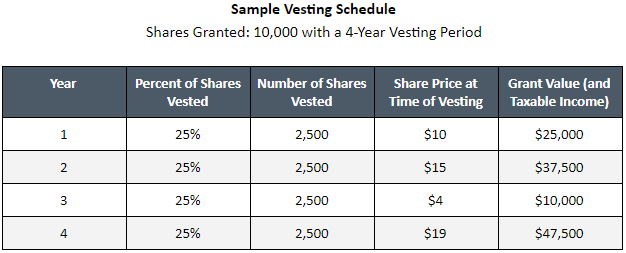
              They’re typically distributed on a pre-set schedule, a process known as “vesting.” For example, your shares may vest over a four-year period. In that case, you may receive 25% of the shares each year (assuming you remain employed with the company).

              Since the shares are distributed over time, it incentives the employee to stay with the company.

              Once the shares vest and are officially yours, you can sell them immediately or continue to hold them. The benefit of holding them is that they may appreciate in value, making them more valuable. This, of course, is not guaranteed. The benefit of selling them is that you convert those shares into cash and use the money for anything you’d like.

              What Are the Taxes?

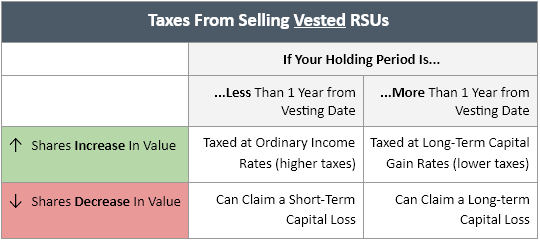
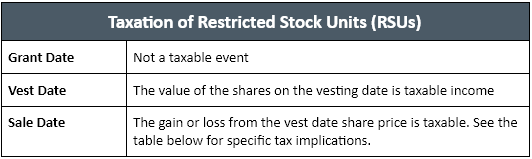
              Just like your salary, the value of restricted stock units are subject to federal and state taxes, including Social Security and Medicare taxes. And similar to a paycheck, the taxes are withheld automatically. This taxation occurs when the shares vest and officially become yours.

              When you sell shares, you will pay either short or long-term capital gains tax on any appreciation above the price of the shares on the vesting date. If you sell the shares at a loss, you can claim that loss against gains made elsewhere in your portfolio.

              Conclusion

              RSUs can be a sizable source of income for employees of publicly-traded companies. As of a result of their unique tax structure (taxed both when the shares vest and when you sell) it may help to talk with an accountant or financial planner to discuss how RSUs fit into your overall financial and tax-planning strategy.

              Subscribe

              Join Our Newsletter

              Sign up to receive an email when new articles are posted.

              The information, analysis, and opinions expressed herein are for general and educational purposes only. Nothing contained in this commentary is intended to constitute legal, tax, accounting, securities, or investment advice, nor an opinion regarding the appropriateness of any investment, nor a solicitation of any type. The material has been gathered from sources believed to be reliable, however Think Different Financial Planning cannot guarantee the accuracy or completeness of such information, and certain information presented here may have been condensed or summarized from its original source. All opinions and views constitute our judgments as of the date of writing and are subject to change at any time without notice.