Weekly Newsletter: The 3-1-1

Weekly Newsletter: The 3-1-1

I hope you’ve had a great week.

Please see this week’s personal finance articles, chart, and quote below, along with a bonus blog post written by me.

3 Articles

How to Buy Happiness (Responsibly)
Ron Lieber, The New York Times

The great reopening offers ample opportunity to lift your spirits if you have some money to spare. Here’s how to do it right.

Why You Should Wait Out the Wild Housing Market
Derek Thompson, The Atlantic

Pick a housing statistic at random, and it’s probably setting an all-time record. Home prices: record high. Inventory: record low. Percentage of homes selling above asking price: record high. Average time on market: record low.

Is $1 Million Still Worth $1 Million
Nick Maggiulli, Of Dollars and Data

There are around 32 million millionaires living in the United States. Based on data from the Survey of Consumer Finances, having $1 million in 2019 would have put you in the top 12% of U.S. households. However, having $1 million in 2001 would have put you in the top 7% of households.

1 Chart

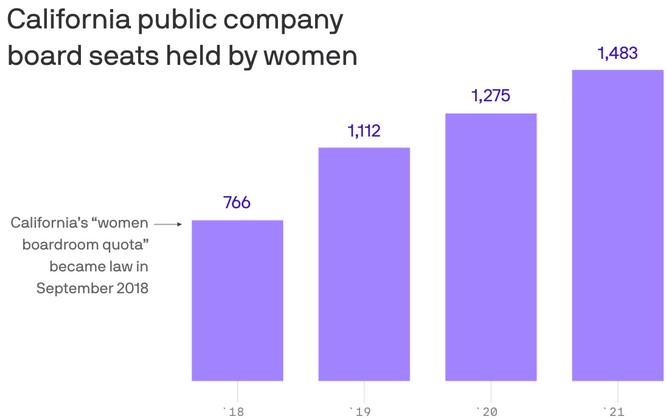
26% of board seats there are now held by women — twice as many as before the law passed.

    1 Quote

    “The trouble with retirement is you never get a day off.”

    – Abe Lemons

      Bonus Content | Written by Will This Week

      Investing Where it’s Comfortable

      US investors are more comfortable holding US-based stocks. The same is true with Canadian, British, and Australian investors. This article describes this “home country bias,” including where it stems from and why it’s to be avoided.

      Subscribe

      Join Our Newsletter

      Sign up to receive an email when new articles are posted.
      Disclosure: The information being provided is strictly as a courtesy/convenience. When you link to any of the web sites provided here, you are leaving this website. We make no representation as to the completeness or accuracy of information provided at these websites.
      Think Different Financial Planning is not liable for any direct or indirect technical or system issues or any consequences arising out of your access to or your use of third-party technology, web sites, information and programs made available through this website.
      When you access one of these web sites, you are leaving this web site and assume total responsibility and risk for use of the web sites you are visiting.
      Think Different Financial Planning does not make any representations or warranties as to the accuracy, timeliness, suitability, completeness, or relevance of any information prepared by any unaffiliated third party, whether linked to Think Different Financial Planning’s web site or incorporated herein, and takes no responsibility thereof.
      Investing Where It’s Comfortable

      Investing Where It’s Comfortable

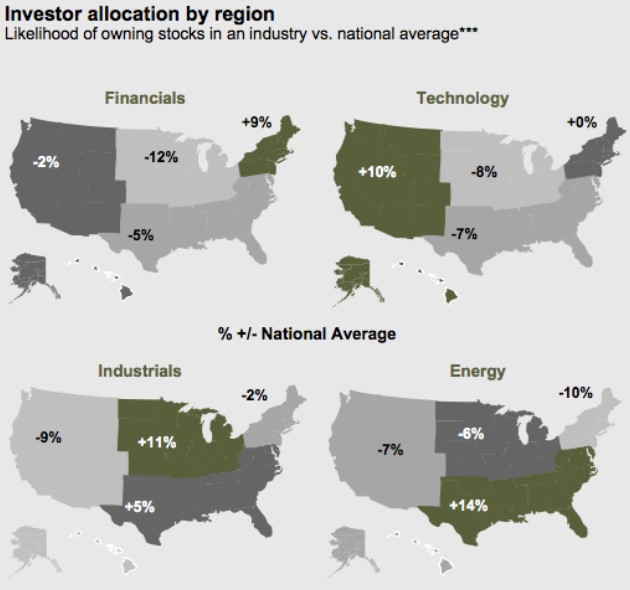
      People invest in things they feel comfortable with. That’s why:


      • Investors on the west coast are more likely to hold technology stocks
      • Investors in the northeast are more likely to hold financial (i.e. bank) stocks
      • Investors in the south more likely to hold energy (i.e. oil) stocks
      • Investors in the midwest are more likely to hold industrial stocks

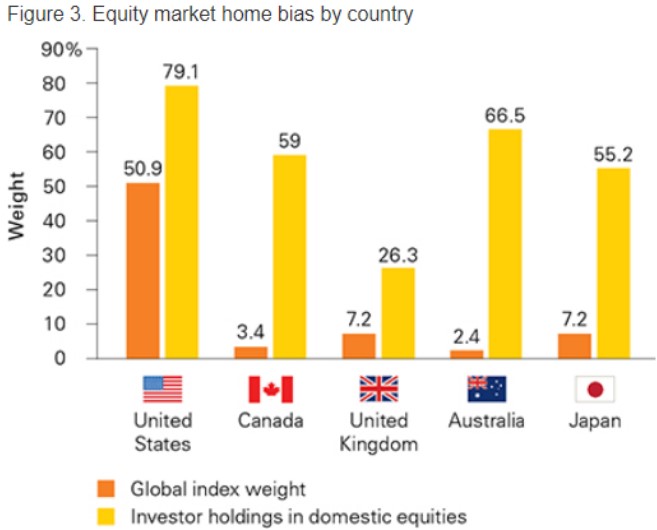
        The same pattern emerges at the domestic level. US investors are more comfortable holding US-based stocks. This is called “home country bias,” and it means investors have a tendency to favor companies from their own country as compared to those from other countries.

        This is not just a US-based bias. Investors across the world do the same thing:

        The average American is ~80% exposed to the US, despite the American stock market being around half the global weight.

        The average Canadian is ~60% exposed to the Canadian stock market, despite it being only 3% of the global weight.

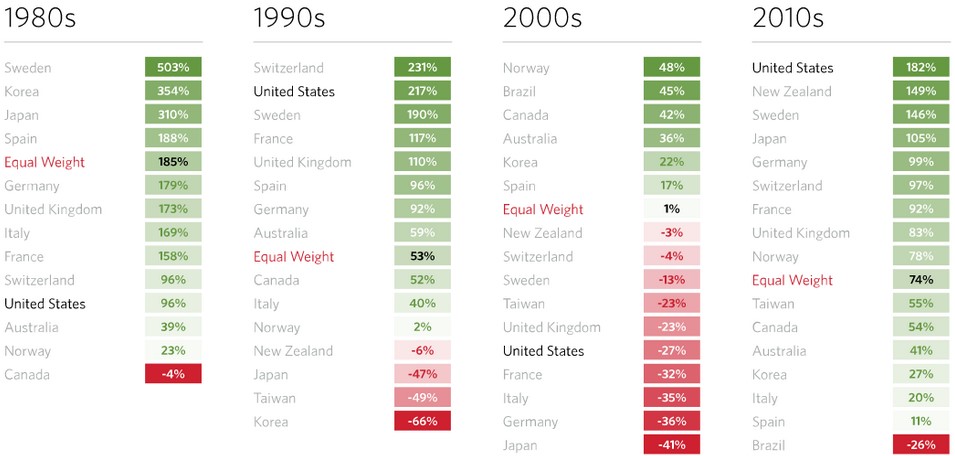
        If you are a US-based investor who is overly concentrated in US stocks, this approach has turned out very well over the past decade:

        But if you look back over the previous decades, it’s clear that the performance of each country ebbs and flows. Knowing that it’s impossible to predict which sector or stock market will perform the best, we diversify.

        While it might feel more comfortable to invest locally, buying international companies provides exposure to great international businesses: Toyota, Nestle, Roche, and many more. In fact, there are about twice as many stocks listed internationally as there are in the US (source #1, source #2)

        When setting up your portfolio, be mindful of home country bias, don’t concentrate too much of your investments in your domestic market, and diversify internationally.

        Subscribe

        Join Our Newsletter

        Sign up to receive an email when new articles are posted.
        The information, analysis, and opinions expressed herein are for general and educational purposes only. Nothing contained in this commentary is intended to constitute legal, tax, accounting, securities, or investment advice, nor an opinion regarding the appropriateness of any investment, nor a solicitation of any type. The material has been gathered from sources believed to be reliable, however Think Different Financial Planning cannot guarantee the accuracy or completeness of such information, and certain information presented here may have been condensed or summarized from its original source. All opinions and views constitute our judgments as of the date of writing and are subject to change at any time without notice.
        Weekly Newsletter: The 3-1-1

        Weekly Newsletter: The 3-1-1

        Happy Friday!

        Please see this week’s personal finance articles, chart, and quote below, along with a bonus blog post written by me.

        I hope you have a great Memorial Day weekend!

        3 Articles

        Play Your Own Game
        Morgan Housel, Collaborative Fund

        We’re all playing different “games” when it comes to investing. Twenty-year-olds trying to learn about markets have different desires than 48 year-olds saving for their kids’ college. Figure out what game you’re playing, then play it.

        Grab An Umbrella
        Adam Grossman, Humble Dollar

        On the importance of umbrella insurance.

        What Can You Do About High Stock Market Valuations?
        Charlie Bilello, Compound Advisors

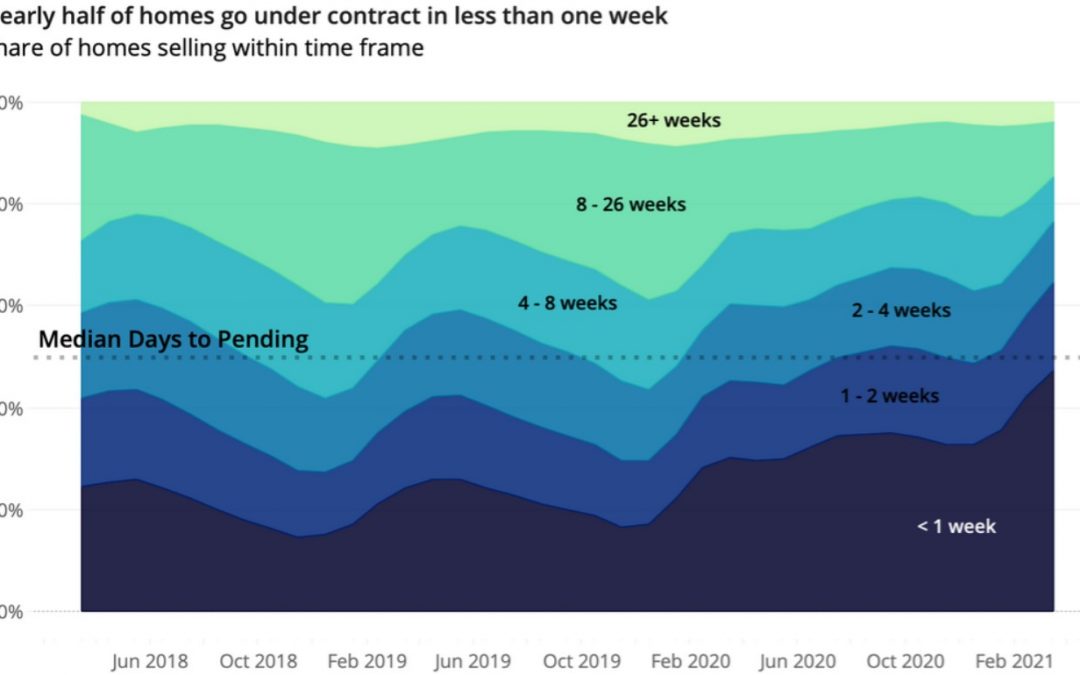
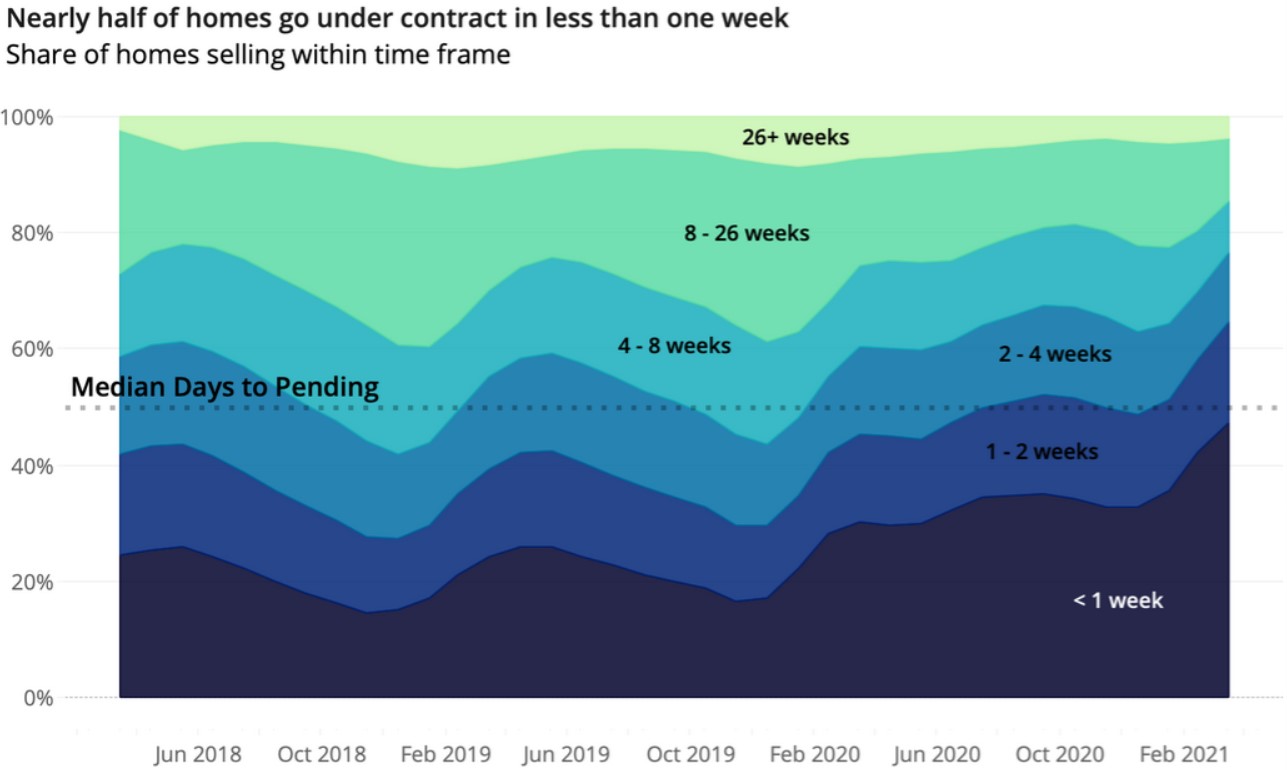
        1 Chart

        Note the rise in home sales occurring in less than a week!

          1 Quote

          “The real measure of your wealth is how much you’d be worth if you lost all your money.”

          – Anonymous 

            Bonus Content | Written by Will This Week

            Subscribe

            Join Our Newsletter

            Sign up to receive an email when new articles are posted.
            Disclosure: The information being provided is strictly as a courtesy/convenience. When you link to any of the web sites provided here, you are leaving this website. We make no representation as to the completeness or accuracy of information provided at these websites.
            Think Different Financial Planning is not liable for any direct or indirect technical or system issues or any consequences arising out of your access to or your use of third-party technology, web sites, information and programs made available through this website.
            When you access one of these web sites, you are leaving this web site and assume total responsibility and risk for use of the web sites you are visiting.
            Think Different Financial Planning does not make any representations or warranties as to the accuracy, timeliness, suitability, completeness, or relevance of any information prepared by any unaffiliated third party, whether linked to Think Different Financial Planning’s web site or incorporated herein, and takes no responsibility thereof.
            How to Beat 86% of Investors with 1% of the Effort

            How to Beat 86% of Investors with 1% of the Effort

            In most areas of life, the more you spend on a product the better it is. Take cars, for example: A $90,000 Tesla is undeniably nicer than a $30,000 Toyota. 

            Many people apply the same logic to investing: the more you pay for an investment manager, the better they must be. 

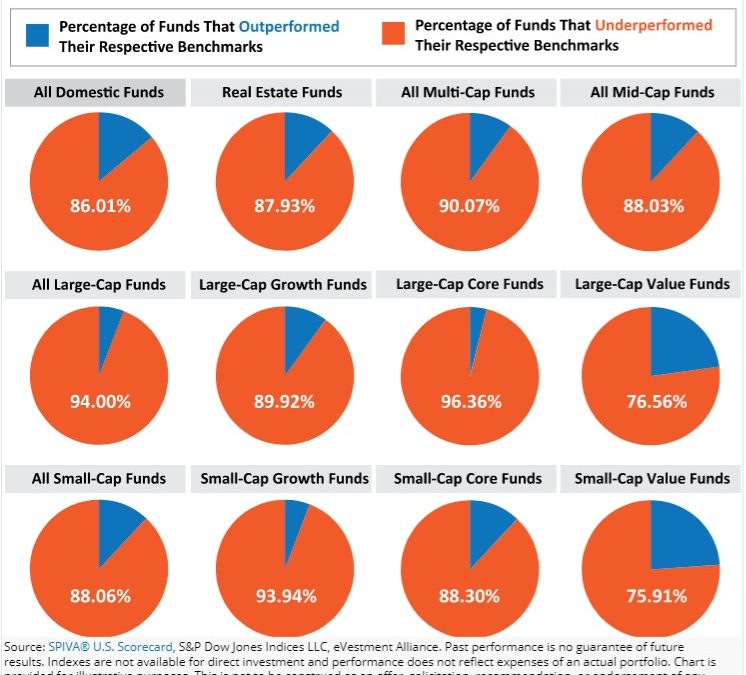
            But with investments, that rule does not apply. In fact, the funds that charge the most tend to perform the worst. (source)

            Investing Choices
            When choosing to invest you have two high-level options:

            Actively Managed Funds: These rely on the skill and expertise of a team of investment professionals to choose which companies to own in order to generate superior returns (i.e., beat the market).

            Actively managed funds cost ~1% per year (source), a fee known as the “expense ratio.” But, the thinking goes, the managers’ stock-picking skills will provide outperformance, thus justifying the cost.

            Passively Managed Funds: Instead of trying to beat the index (for example, the S&P 500), these funds simply own all the stocks that make up the S&P 500, mirroring its performance.

            Since no managers are employed to research which stocks to own, these funds cost less. The typical expense ratio is ~0.20% but can be as low as 0.02% (source)

            What’s The Evidence?
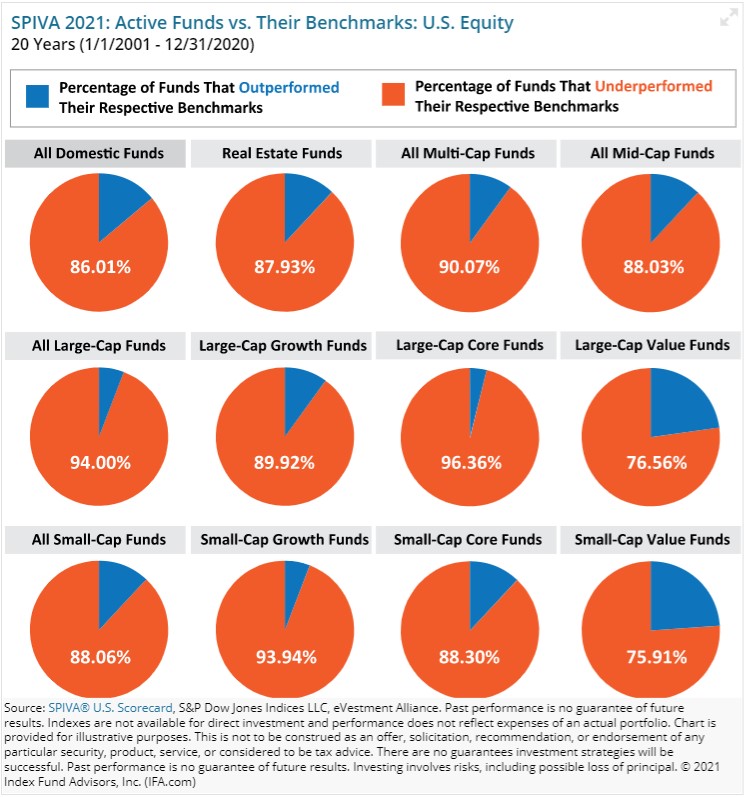
            The vast majority of actively managed funds do not beat their benchmark:

              Across the US, over the past 20 years 86% of active funds have failed to beat their benchmark. (source)

              The same pattern is also evident within international stock markets and the bond market. (source)


              What Should Investors Do?
              Instead of picking funds that aim to outperform (but typically do not), investors should utilize passive funds. This advice is not only supported by empirical evidence but also many well-known investors:

              Purchasing an investment is not like buying a car. 

              “In investing, you get what you don’t pay for. Costs matter…intelligent investors will use low-cost index funds to build a diversified portfolio of stocks and bonds.”

              – Jack Bogle

              Subscribe

              Join Our Newsletter

              Sign up to receive an email when new articles are posted.
              The information, analysis, and opinions expressed herein are for general and educational purposes only. Nothing contained in this commentary is intended to constitute legal, tax, accounting, securities, or investment advice, nor an opinion regarding the appropriateness of any investment, nor a solicitation of any type. The material has been gathered from sources believed to be reliable, however Think Different Financial Planning cannot guarantee the accuracy or completeness of such information, and certain information presented here may have been condensed or summarized from its original source. All opinions and views constitute our judgments as of the date of writing and are subject to change at any time without notice.
              Weekly Newsletter: The 3-1-1

              Weekly Newsletter: The 3-1-1

              I hope you’re doing well and having a great week.

              Please see this week’s content below. I’ve also included a bonus article I wrote about Yale’s former endowment manager, who had a profound impact on the investment world and recently passed away.

              3 Articles

              7 Money Personality Types, and The Pitfalls of Each
              Ken Honda, CNBC

              From the “Compulsive Spender” to “The Worrier,” we each have our money personality. This article highlights each one, along with its downside.

              Inflation is Here. But is it Here to Stay?
              Michael Batnick, The Irrelevant Investor

              The largest price increases are happening in areas that were directly impacted by the pandemic. But it also helps to “look under the hood,” because the headline number doesn’t tell the whole story.

              Five Investing Powers
              Morgan House, Collaborative Fund

              Helpful investing “powers” that will benefit you: low susceptibility to FOMO, recognizing the difference between patience and stubbornness, and more.

              1 Chart

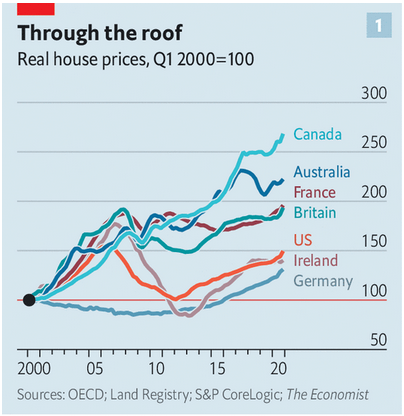
              Real estate prices around the world are on the rise. 

                1 Quote

                “If you look at life through the framework of money you’ll miss most of the picture.”

                – Dave Chapelle 

                  Subscribe

                  Join Our Newsletter

                  Sign up to receive an email when new articles are posted.
                  Disclosure: The information being provided is strictly as a courtesy/convenience. When you link to any of the web sites provided here, you are leaving this website. We make no representation as to the completeness or accuracy of information provided at these websites.
                  Think Different Financial Planning is not liable for any direct or indirect technical or system issues or any consequences arising out of your access to or your use of third-party technology, web sites, information and programs made available through this website.
                  When you access one of these web sites, you are leaving this web site and assume total responsibility and risk for use of the web sites you are visiting.
                  Think Different Financial Planning does not make any representations or warranties as to the accuracy, timeliness, suitability, completeness, or relevance of any information prepared by any unaffiliated third party, whether linked to Think Different Financial Planning’s web site or incorporated herein, and takes no responsibility thereof.
                  Financial Priorities in your 30’s and 40’s

                  Financial Priorities in your 30’s and 40’s

                  Your 30’s and 40’s tend to be the years when you start earning real money. If you’re in that age range here are the top financial priorities:

                  Pay Off Debt
                  Paying off non-mortgage related debt should be a top priority. Whether it stems from college loans, credit cards, or elsewhere, the higher the interest rate the higher the priority it should be. If you can afford to pay more than the required monthly amount, do it. You’ll pay off the loan sooner and save on interest.

                  Have an Emergency Savings Account
                  Cash reserves help cover expected and unexpected costs. If your car breaks down, your roof leaks, or you have a surprise medical cost, you’ll need cash.

                  How much cash? That’s a personal decision and there’s no “right” number, but I suggest at least 4 – 6 months of your post-tax salary. That number, however, depends on a few factors:

                  • How stable is your job? If it’s stable, you could argue for holding less cash. If it’s unsteady, such as a commission-based job, a larger allocation is sensible.
                  • For some people, having a lot in cash simply helps them sleep better at night. There’s nothing wrong with that.
                  • If your spouse works, can you afford to live off one income if either of you unexpectedly loses your job?

                  Fund your 401(k) or 403(b)
                  At minimum, contribute enough so you receive the full company match, if that’s offered.

                  If you’re contributing to a pre-tax 401(k) those contributions will lower your taxable income, meaning you’ll save on taxes.

                  Try to save at least 10% of your income.

                  Set Up Life and Disability Insurance
                  If you have a spouse and children, consider what would happen to your family’s finances if you or your spouse passed away or became disabled and were unable to work. Insurance protects against these rare but catastrophic events. While it’s not fun to think about, having the appropriate level of insurance in place is important.

                  Determine the Right Investment Allocation
                  For your investment accounts, determine if you’re comfortable with, say, an 80% stock allocation and 20% in bonds versus something more conservative or aggressive.

                  It’s helpful to understand the past upside and downside performance during various periods.

                  Once an allocation decision is made, stick with it unless your risk tolerance, timeframe, or other changes arise.

                  Subscribe

                  Join Our Newsletter

                  Sign up to receive an email when new articles are posted.
                  The information, analysis, and opinions expressed herein are for general and educational purposes only. Nothing contained in this commentary is intended to constitute legal, tax, accounting, securities, or investment advice, nor an opinion regarding the appropriateness of any investment, nor a solicitation of any type. The material has been gathered from sources believed to be reliable, however Think Different Financial Planning cannot guarantee the accuracy or completeness of such information, and certain information presented here may have been condensed or summarized from its original source. All opinions and views constitute our judgments as of the date of writing and are subject to change at any time without notice.